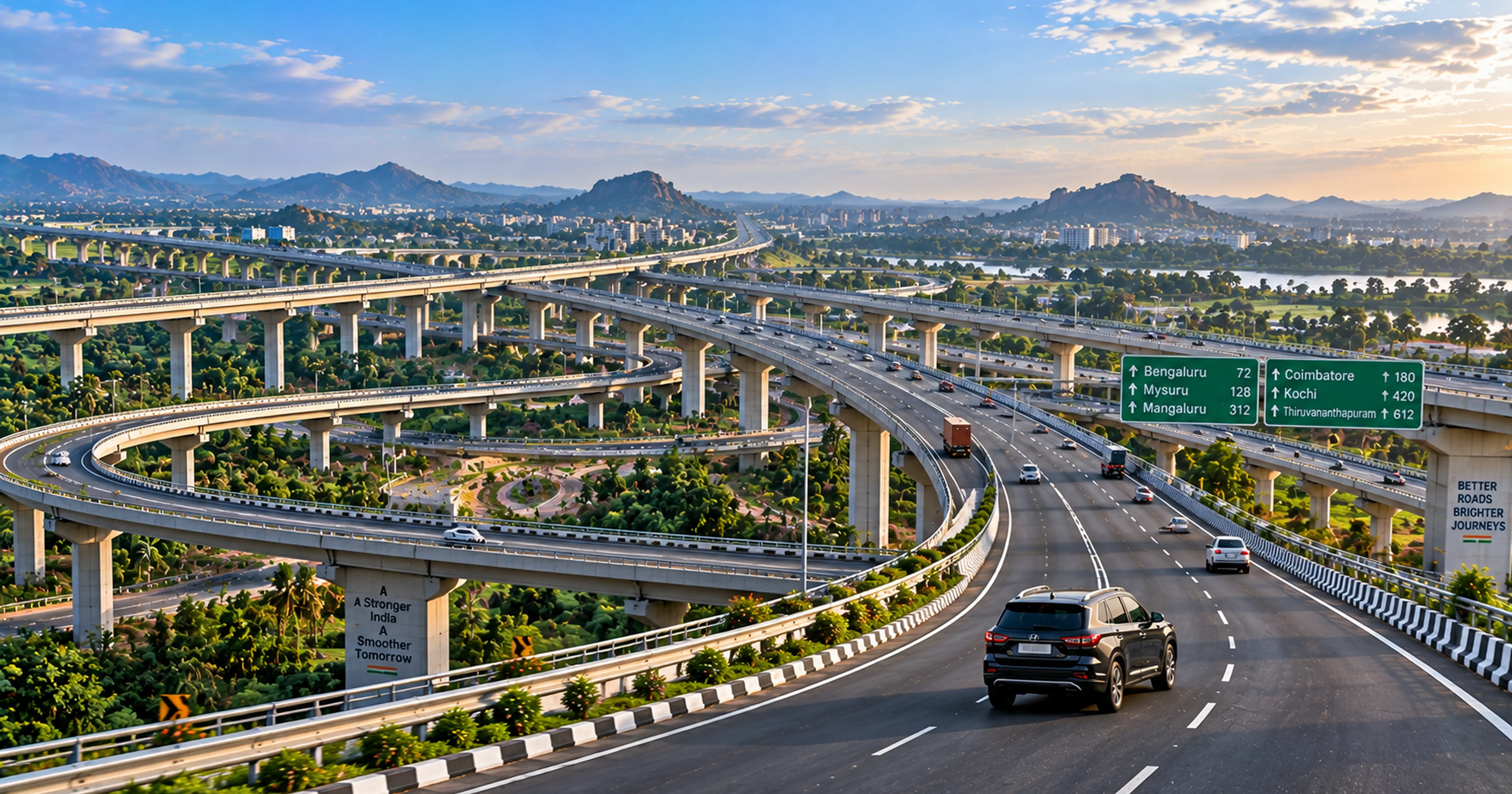
India is building roads faster than at any point in its history. The National Highways Authority of India built 5,613 km of national highways in FY25 — more than 15 km every single day. Under Bharatmala Pariyojana, the most ambitious road programme in Indian history, the country is constructing expressways, ring roads and high-speed corridors that are changing what a road trip means. The Bangalore-Chennai Expressway — NE-7, India's first expressway in South India — already has 100 km operational and will eventually cut the Bangalore-Chennai journey from 5-6 hours to 2 hours 15 minutes. The Delhi-Mumbai Expressway will cut the 24-hour highway drive to 12 hours when complete. Every one of these projects changes what destinations are accessible, what distances feel like, and what a self drive road trip from Chennai or Bangalore can accomplish in a weekend. This is the complete 2026 guide to every new expressway relevant to South India road trippers — what is open, what is delayed, what each one changes, and the MM Miles self drive cars that unlock them.
The Big Picture — India's Expressway Revolution in 2026
India had approximately 1,700 km of expressways in 2015. In 2026, that number has crossed 10,000 km with thousands of kilometres under active construction. The transformation is structural — India is moving from a highway system primarily designed for mixed-speed traffic with grade crossings to a network of access-controlled, high-speed expressways where private vehicles can travel at 100-120 kmph without traffic signals, grade crossings or slow vehicles.
| Expressway | Length | Status 2026 | Travel impact |
|---|---|---|---|
| Bangalore-Chennai NE-7 | 262 km | ~100 km open — full 2027 | 5-6 hrs → 2h 15m |
| Bangalore-Mysore NH275 | 117.5 km | Fully operational ✓ | 3 hrs → 2 hrs |
| Chennai Peripheral Ring Road | 127 km | Sections operational | Bypasses Chennai city |
| Hyderabad Outer Ring Road | 158 km | Fully operational ✓ | Bypasses Hyderabad |
| Delhi-Mumbai Expressway | 1,350 km | Partial sections open | 24 hrs → 12 hrs |
| Surat-Chennai Expressway | 1,271 km | Under construction | Expected 2036 |
<cite index="4-1">NHAI has actually gone past its own goals before, building 5,313 km against a 4,640 km target, and 5,614 km in FY25. For FY26, NHAI has set an ambitious construction target of around 5,000 km.</cite> This pace of construction — 15 km per day on average — is transforming the map of driveable India faster than any previous infrastructure programme.
The Bangalore-Chennai Expressway (NE-7) — The Most Important Expressway for South India Road Trippers
The Bangalore-Chennai Expressway — officially National Expressway 7 (NE-7), also called National Expressway 5 in some documents — is the first expressway in South India and the most significant new road for road trippers from both cities. It is built under Bharatmala Pariyojana by NHAI at an estimated cost of ₹18,000 crore.
Route and Design
<cite index="13-1">The Bengaluru-Chennai Expressway (BCE), designated as National Expressway 7 (NE-7), spans approximately 258 kilometres as a four-lane (expandable to eight lanes) expressway that will significantly cut travel time between Bengaluru and Chennai from over six hours to just three hours.</cite> The route connects Hoskote near Bangalore's eastern outskirts to Sriperumbudur near Chennai — passing through Karnataka (71.7 km), Andhra Pradesh (85.2 km) and Tamil Nadu (106 km). A separate 22.6 km elevated road runs from Sriperumbudur to Maduravoyal at the Chennai end.
<cite index="12-1">After completion, the Chennai Bangalore Expressway will reduce travel time to around 2 hours and 15 minutes. The new route will also reduce the distance between the two cities by nearly 80 km, making long-distance travel faster and fuel-efficient.</cite> The expressway passes through Kolar Gold Fields, Bethamangala, Chittoor district in Andhra Pradesh, Ranipettai and Kanchipuram — connecting areas that were previously distant from major highway infrastructure.
Current Status — What Is Open Right Now
<cite index="8-1">The 71 km Karnataka stretch from Hoskote to the KGF border has been operational since December 2024, and a 25 km Andhra Pradesh section opened in June 2026, taking the total open length to about 100 km. The remaining Andhra and Chennai-end packages are targeted for October 2026.</cite>
The honest current status: <cite index="10-1">officials now expect the complete 262.9-km stretch — spanning Karnataka (71.7 km), Andhra Pradesh (85.2 km), and Tamil Nadu (106 km) — to become operational sometime in 2027. More than 230 km of the corridor has been completed so far, including 71.7 km of Karnataka, 78.5 km of the planned 85.2 km in Andhra Pradesh, and above 80 km in Tamil Nadu.</cite> The project has missed its third deadline due to legal disputes over land acquisition in the Tamil Nadu section.
| Section | Length | Status | Open since |
|---|---|---|---|
| Karnataka — Hoskote to KGF border | 71.7 km | Fully open — toll-free ✓ | December 2024 |
| Andhra Pradesh — partial | ~25 km | Open ✓ | June 2026 |
| Andhra Pradesh — remaining | ~60 km | Targeted October 2026 | Pending |
| Tamil Nadu — full section | 106 km | Under construction — legal delays | 2027 expected |
| Chennai elevated section | 22.6 km | Under construction | 2027 expected |
Road trippers from Bangalore heading toward Kolar Gold Fields or the Andhra Pradesh border can already use the 71.7 km Karnataka section from Hoskote. The section is toll-free and offers the high-speed, access-controlled expressway experience with smooth tarmac, clear signage and no grade crossings. Take the Hoskote interchange from NH-44 to access it.
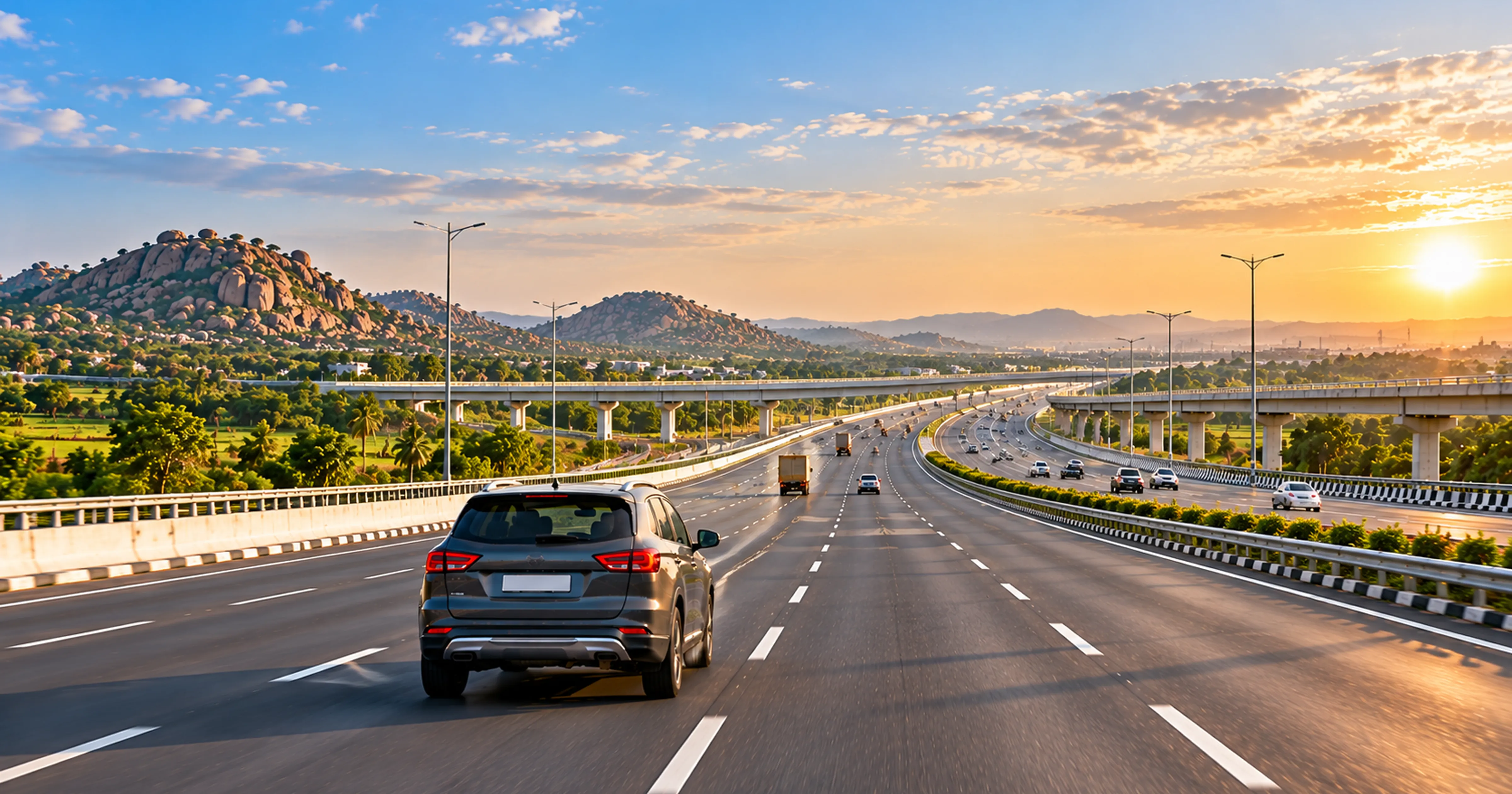
What NE-7 Means for Weekend Road Trips — The New Destinations
When the Bangalore-Chennai Expressway is fully open in 2027, it will create three specific road trip opportunities that do not currently exist at this scale:
- Bangalore to Chennai as a genuine weekend trip: At 2 hours 15 minutes, Chennai day trips from Bangalore and Bangalore day trips from Chennai become realistic. Marina Beach from Bangalore — 2h15m. Cubbon Park from Chennai — 2h15m. Two cities that previously required overnight trips now connect in less time than Bangalore to Mysore currently takes in peak traffic.
- Kolar Gold Fields — a destination in its own right: The expressway passes through KGF, the historic gold mining town made famous by the KGF movie franchise. With direct expressway access 71 km from Bangalore, KGF day trips become straightforward. Robertsonpet town, the Kolar Gold Fields heritage structures, the landscape that inspired one of India's biggest films.
- Chittoor district in Andhra Pradesh becomes accessible: The expressway opens a previously highway-distant section of Andhra Pradesh for road trippers. Tirumala Tirupati from Bangalore via the new expressway and NH40 becomes significantly faster than the current NH-48 route.
Bangalore-Mysore Expressway NH275 — Already Transforming Road Trips
While NE-7 is still partial, the Bangalore-Mysore Expressway on NH275 is fully operational and already the most-used expressway for South India road trips. The 117.5 km six-lane access-controlled expressway from Bangalore to Mysore has transformed what used to be a 3-hour congested drive into a smooth 2-hour journey — with no traffic signals, no heavy vehicle congestion, and a consistent 100-120 kmph travel speed for the main corridor.
The NH275 expressway has the most direct road trip impact of any completed South India highway: Bangalore to Mysore in 2 hours. Bangalore to Coorg in 4 hours (via NH275 to Kushalnagar). Bangalore to Wayanad in 4.5 hours (via NH275 to Mysore then toward the Kerala border). Bangalore to Ooty in 5.5 hours (via NH275, Mysore, Gundlupet, then NH181). Every one of these routes is faster, more comfortable and more fuel-efficient on NH275 than the old state road alternatives.
Chennai Peripheral Ring Road — The City Bypass Road Trippers Need
For road trippers travelling through Chennai rather than to it — connecting from Bangalore to Pondicherry or Mahabalipuram — the Chennai Peripheral Ring Road (CPRR) is specifically designed to eliminate the need to navigate Chennai's internal traffic. The 127 km outer ring road allows vehicles to bypass the city entirely, connecting the northwestern entry from Bangalore to the southern ECR exit toward Pondicherry without entering the urban traffic zone.
The CPRR is progressively becoming operational in sections. When fully complete, a Bangalore to Pondicherry road trip will be able to bypass Chennai's 60-90 minute internal traffic entirely — taking the ring road from the NH-48 entry point to the ECR exit in approximately 25-30 minutes. For road trippers, this converts a Bangalore-Pondicherry trip from a 7-8 hour drive to a 5.5-6 hour drive.
The Delhi-Mumbai Expressway — India's Most Ambitious Road
<cite index="4-1">At 1,350 km and ₹1,00,000 crore, this is India's most ambitious road project. Partially opened in phases since 2023, it will cut Delhi-Mumbai travel time from ~24 hours to just 12 hours when fully complete.</cite> The Delhi-Mumbai Expressway passes through Rajasthan, Madhya Pradesh and Gujarat before reaching Mumbai. While not directly relevant to South India road trips, it signals the scale of India's expressway ambition — a journey that once required two full days now becomes a single overnight drive.
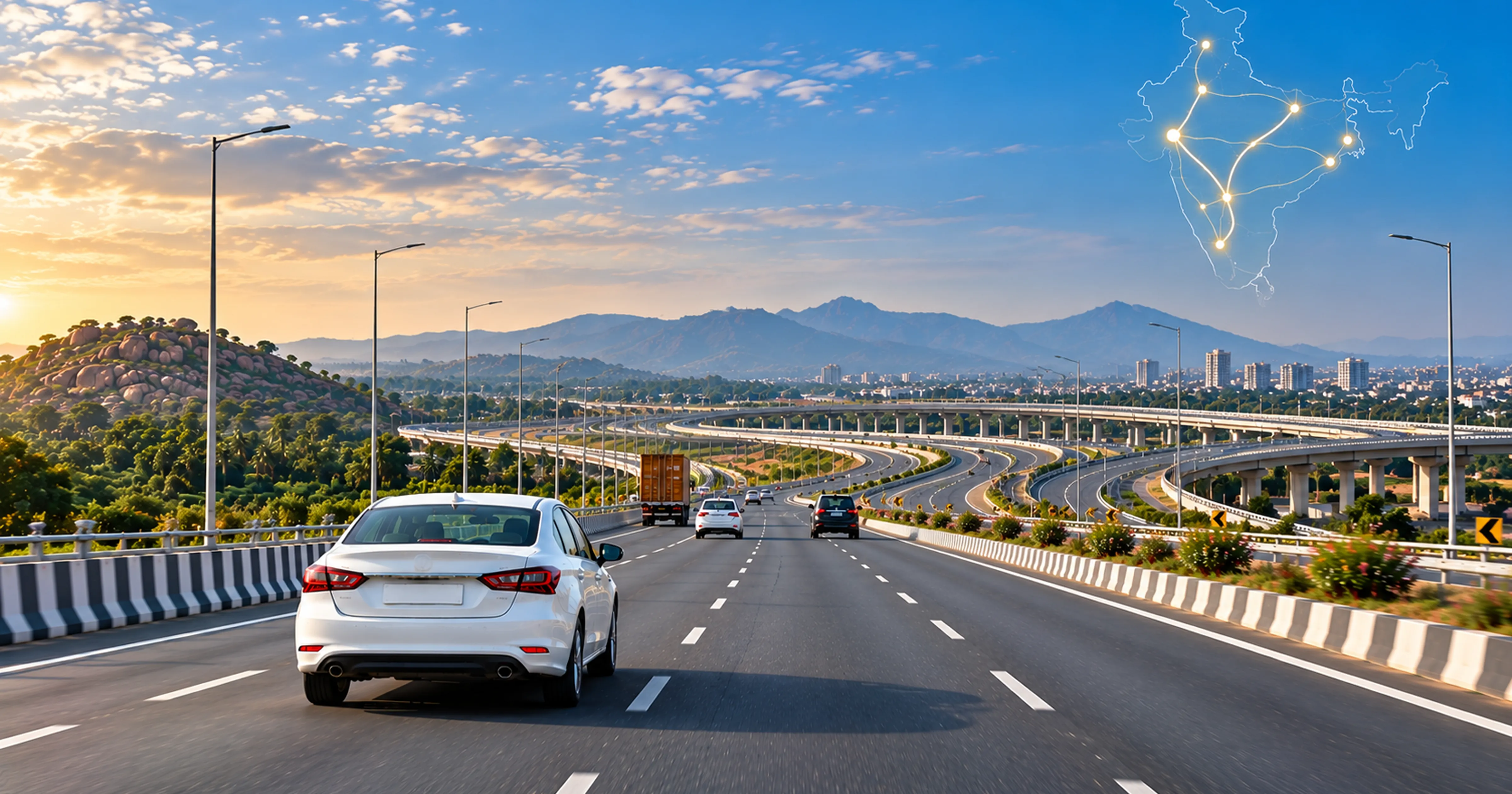
Hyderabad Outer Ring Road — The South India Expressway Already Delivering
The Hyderabad Outer Ring Road (ORR) — 158 km of eight-lane expressway — is fully operational and the best example of what a ring road does for a major city. For road trippers from Bangalore heading to Hyderabad and beyond, the ORR allows bypassing Hyderabad's 1.5-2 hour internal traffic entirely — exiting at the specific interchange for the destination rather than navigating through the city. The Bangalore-Hyderabad drive via NH-44 and the ORR takes 9-10 hours with the bypass — versus 11-12 hours through city traffic.
What New Expressways Mean for MM Miles Road Trippers — The Practical Impact
- Shorter drive times mean more trips per weekend: When Bangalore to Chennai becomes 2h15m, a day trip from Bangalore to Marina Beach becomes realistic. When Delhi to Mumbai becomes 12 hours, it becomes a weekend drive rather than a flight route. Every expressway that opens converts a destination from 'requires overnight' to 'day trip possible.'
- Fuel savings from high-speed consistent driving: Expressway driving at 100-120 kmph in top gear is significantly more fuel-efficient than highway driving with frequent acceleration-deceleration at grade crossings. The Bangalore-Mysore NH275 at consistent 110 kmph returns 18-22 kmpl on a diesel Creta versus 14-16 kmpl on the old state road with stops. The fuel saving on every expressway trip partially offsets the toll cost.
- Lower cab and transport costs for the same journey: When road quality improves and drive times fall, the cost of all forms of road transport on that route falls. NH275 opened competition — Bangalore-Mysore cabs dropped in price when the expressway made the journey faster and more predictable for drivers. NE-7 will do the same for Bangalore-Chennai when complete.
- FASTag essential on every new expressway: All Bharatmala expressways are fully cashless — FASTag mandatory, cash rejected, double toll for non-FASTag vehicles. MM Miles cars come pre-fitted with active FASTag. Confirm FASTag balance with MM Miles team before any expressway trip.
- New weekend destinations emerge with every expressway: Kolar Gold Fields is the current example — previously a 3-hour congested drive, now 71 km from Hoskote on the NE-7 expressway section. Every new expressway creates this effect — towns and destinations along the route that were effectively too far for a weekend trip become accessible.
Expressway Speed Limits and Rules — What Every Road Tripper Must Know
| Rule | National expressway standard | Penalty for violation |
|---|---|---|
| Maximum speed — cars | 100-120 kmph depending on section | ₹1,000-2,000 fine, challan |
| Minimum speed | 60 kmph on most expressway sections | Warning or fine |
| Pedestrian crossing | Prohibited — use underpasses | ₹500 fine |
| U-turns | Prohibited — use designated exits | ₹500 fine |
| Stopping on carriageway | Prohibited except emergency | ₹500-1,000 fine |
| Overtaking from left | Prohibited | ₹500 fine |
| Mobile phone while driving | Prohibited | ₹5,000 fine |
| Two-wheelers and tractors | Not permitted on expressways | Vehicle impounded |
| FASTag requirement | Mandatory — cash rejected | Double toll charge |
The speed limit of 100-120 kmph is the maximum — it is not a target. On wet roads, in reduced visibility or in heavy traffic sections near interchanges, reduce speed appropriately. Expressways in India do not have traffic signals or pedestrian crossings — but they do have emergency stopping bays every 25-30 km for breakdowns. If your MM Miles car has any issue on an expressway, pull into the nearest emergency bay and call MM Miles 24/7 support immediately.
For official NHAI expressway project status and toll information visit nhai.gov.in. For Bharatmala Pariyojana project updates visit the Ministry of Road Transport and Highways at morth.nic.in. For NE-7 specific updates and toll rate announcements visit the NHAI project page at nhai.gov.in/category/expressway.
Ready to drive the NE-7 Karnataka section or the NH275 Mysore Expressway? MM Miles delivers FASTag-fitted self drive cars to your Bangalore door — ₹799/day, zero deposit, unlimited km. The expressways are opening. The car is ready.
Book Self Drive Car in Bangalore →Chennai road tripper? Bypass the city on the Peripheral Ring Road and drive directly to Pondicherry or Mahabalipuram. MM Miles at ₹799/day, home delivery, active FASTag fitted. Drive India's new expressways today.
Book Self Drive Car in Chennai →