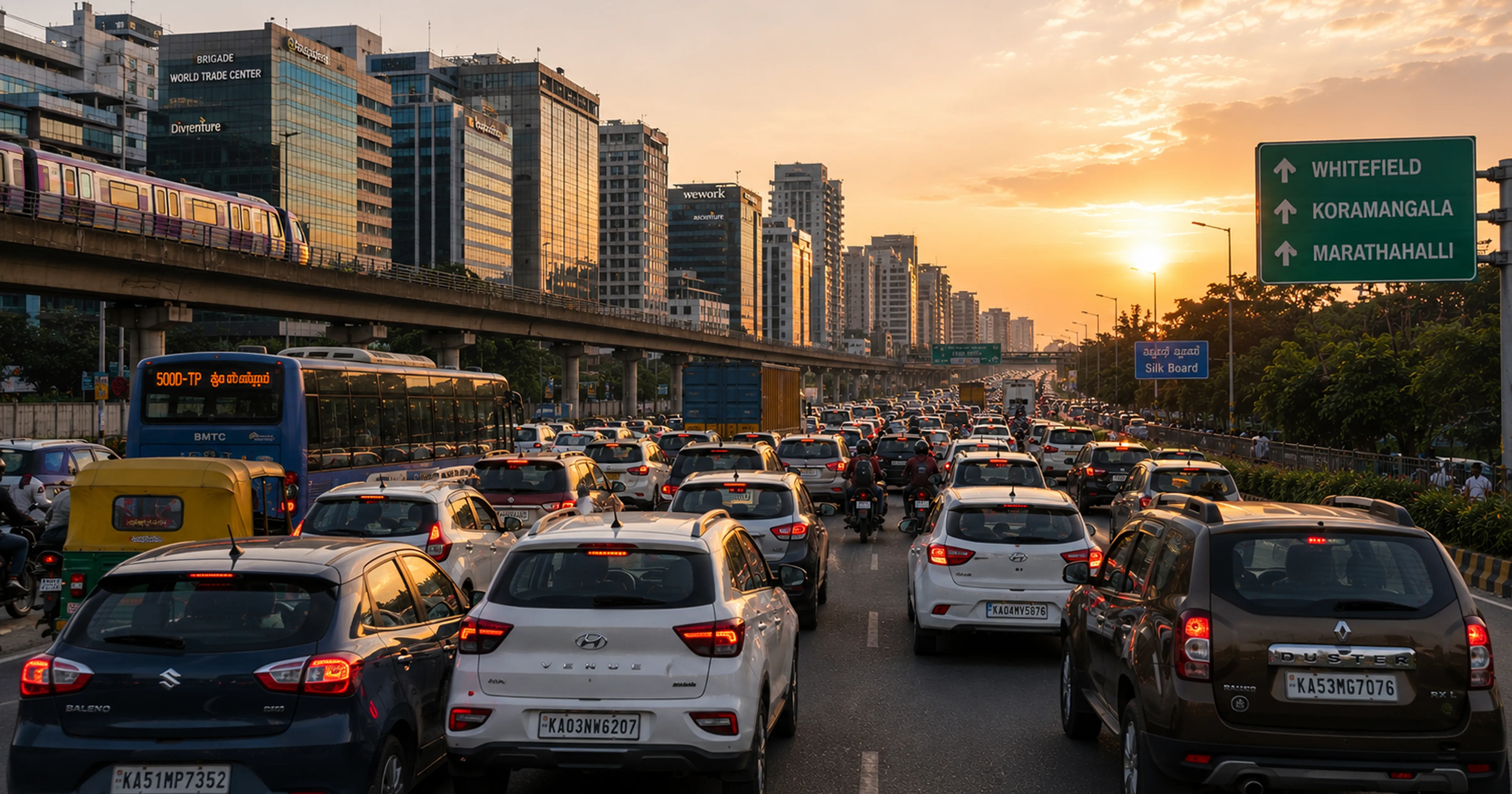
It was 3:30 AM. A Bangalore resident posted to r/bangalore — a Reddit post titled 'Blr Infra is collapsing.' His journey from Indiranagar to Manyata Tech Park had taken nearly two hours. The distance: six kilometres. Not during office hours. Not during the 8-10 AM rush. At 3:30 AM, when the city should have been empty. The post described it as 'the worst condition I've seen in 10 years in Bangalore.' The TomTom Traffic Index 2025 — published by Dutch geolocation technology company TomTom, analysing data from over 3.65 trillion kilometres of global travel — confirmed what every Bangalore resident already knows. The city is the world's second most congested, having climbed from sixth in 2023 to third in 2024 to second in 2025. The average peak hour speed is 13-14 kmph. A 12 km office run takes longer than a 60 km highway trip outside the city. Commuters lose 168 hours — seven full days — to traffic every year. This blog covers what is actually causing this, which junctions and corridors are worst, and what self drive car rental from MM Miles specifically changes about your daily experience of Bangalore's traffic.
The Numbers That Define Bangalore Traffic in 2026
The TomTom Traffic Index 2025 ranks Bangalore as the world's second most congested city — behind only Barranquilla, Colombia. This is a significant deterioration: sixth in 2023, third in 2024, second in 2025. Each year the time to drive 10 km has increased and average speeds have fallen.
| Metric | Bangalore 2026 reality |
|---|---|
| Global congestion rank | #2 in the world (TomTom 2025) |
| Average peak hour speed | 13–14 kmph |
| Time for 10 km in peak hours | 34 minutes 10 seconds (2024 data) |
| Hours lost per commuter per year | 168 hours — 7 full days |
| Worst morning queue | Gokaldas Images Junction — 9.9 km |
| Worst evening queue | Veerannapalya near BEL — 15.8 km |
| Worst day recorded (2025) | May 17 — 15 minutes to cover 2.5 km |
| Congestion level | 74.4% average |
| Annual economic cost | ₹37,000 crore |
The 168 hours per year is the number that deserves attention. Seven full working days — gone. Not spent at work, not spent with family, not spent on anything productive. Simply lost to sitting in traffic. At a modest salary of ₹12 lakh per year, the time value of those 168 hours is approximately ₹96,000 per commuter annually — a financial cost that does not appear in any transport budget calculation.
The 5 Worst Corridors and What Is Causing Them
1. Outer Ring Road — The Daily Nightmare
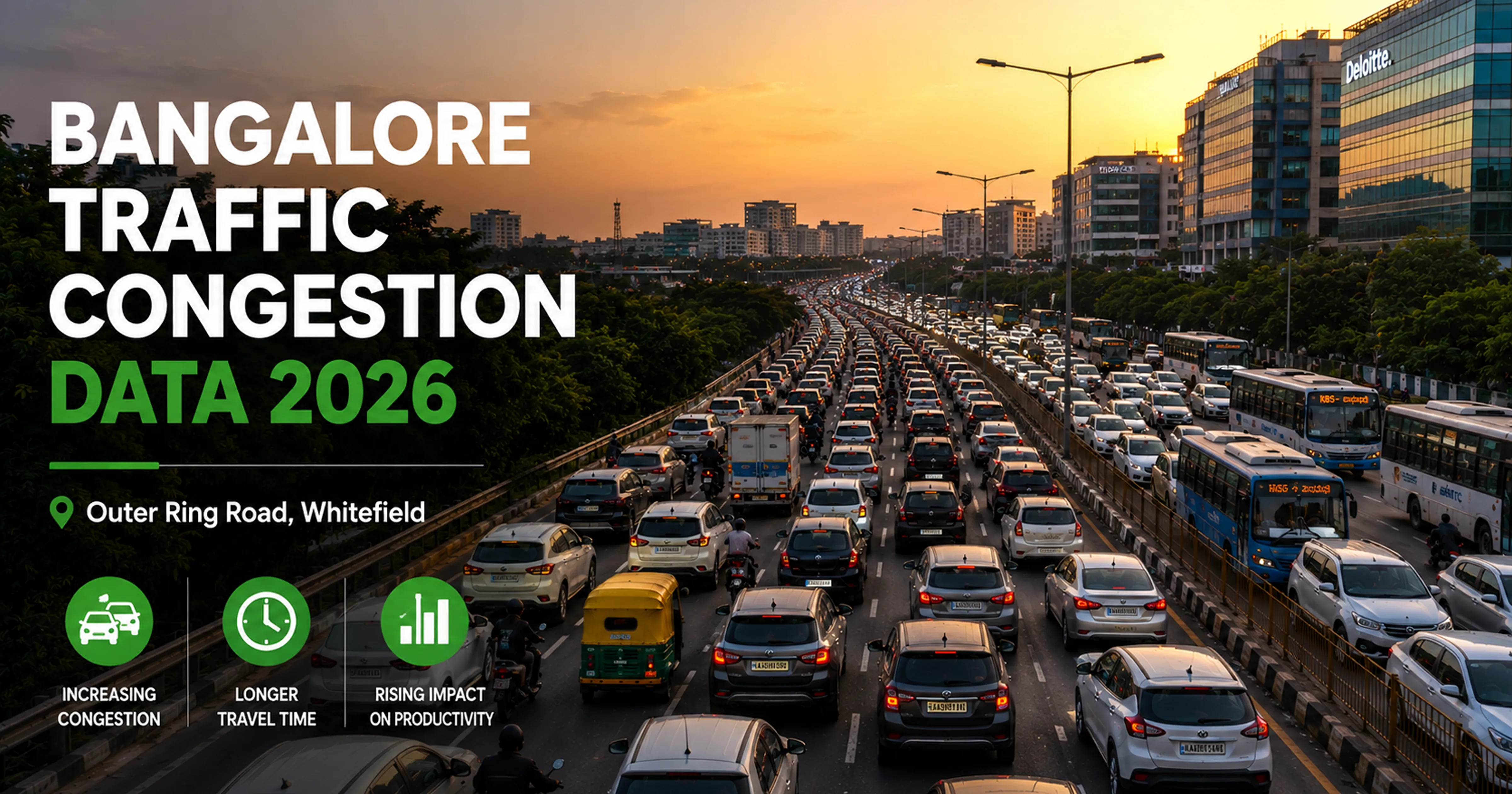
The Outer Ring Road from Hebbal to Silk Board is Bangalore's most chronic traffic corridor — the spine of the city's IT sector connecting major tech parks. Cisco, SAP, Microsoft, Infosys and hundreds of other companies have offices along this stretch. The demand is concentrated into two narrow windows — 8-10 AM and 6-8 PM — creating demand spikes that the road physically cannot accommodate. Bangalore Traffic Police data shows queues extending more than 10 km at key junctions during evening rush. The ongoing metro construction on Phase 3 has further reduced road width at multiple points along the ORR, worsening a situation that was already at capacity.
2. Whitefield — The IT Hub That Broke Its Own Infrastructure
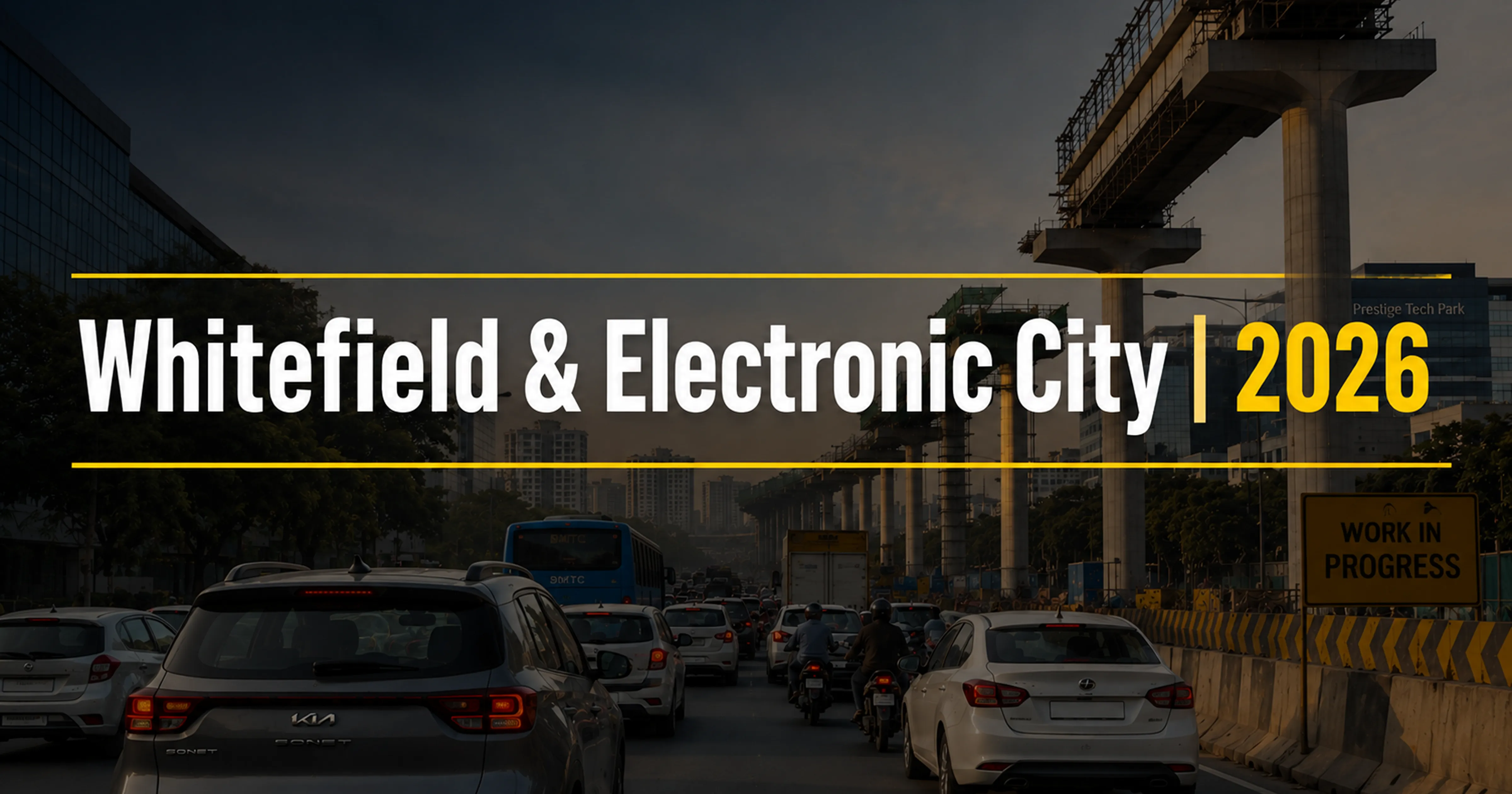
Whitefield was designed as a satellite township. It became one of India's largest IT employment zones with no corresponding infrastructure upgrade. EPIP Zone, ITPB and the surrounding tech parks employ hundreds of thousands of IT professionals. The road network serving Whitefield — primarily the Old Airport Road and Whitefield Main Road — was not designed for this volume. Peak hour cab cancellations in Whitefield are among the highest in the city. The Namma Metro Purple Line extension to Whitefield opened in 2023 but has not significantly reduced road congestion, which continues to worsen year on year.
3. Electronic City — Elevated Expressway Above, Gridlock Below
The NICE Road elevated expressway was built specifically to serve Electronic City. It reduced the commute time significantly for expressway users — but the access roads feeding the expressway have not kept pace. Hosur Road, Sarjapur Road and the Electronic City Phase 1 and Phase 2 entry points are chronically congested during peak hours. Infosys, Wipro and HCL campuses collectively employ tens of thousands — and most employees still commute by road. Evening peak from Electronic City begins as early as 4:30 PM as employees try to leave before the worst window, compressing what was previously a 2-hour peak into a 4-hour congestion period.
4. Metro Construction Junctions — New Congestion Added to Old
Bangalore's metro expansion — Phase 3 covering the Airport Line, Outer Ring Road West and Hebbal connections — is creating new congestion points on top of existing ones. Joint Commissioner of Police (Traffic) Karthik Reddy acknowledged directly: 'The situation was exacerbated by the metro construction, which has slowed down traffic even further.' The construction is temporary — but temporary in Bangalore's infrastructure timeline means years, not months. The Deccan Herald reported junctions with queues exceeding 10 km related specifically to metro construction narrowing road widths.
5. Tuesday and Wednesday — The Worst Days Nobody Plans For
Bangalore's congestion pattern has shifted in a counterintuitive way. The Joint Commissioner of Police noted: 'Tuesday and Wednesday are the heaviest for peak hour traffic. With many employees taking Monday or Friday offs for long weekends, the midweek period sees the maximum convergence of the city's workforce on the roads.' Most commuters plan around Friday evening congestion. The heavier congestion is actually mid-week — a data point that changes when to schedule important meetings, when to book cabs and when to use self drive flexibility to adjust departure timing.
Why Cabs Make Bangalore Traffic Worse for You Specifically
Cab aggregators in Bangalore face a compounding problem that directly affects individual riders. During peak hours when the city is most congested, cab availability drops — drivers are stuck in the same traffic and cannot complete rides efficiently. When availability drops, surge pricing activates. The exact moment you most need a reliable, affordable ride is when cabs are least available and most expensive. A 78% of Bangalore Ola users cited surge pricing as their top complaint in a LocalCircles survey — and surge pricing is worst during the peak hours when congestion is worst. The two problems reinforce each other.
Cab cancellations in Whitefield during 8-9 AM peak average 20-25 minutes waiting time. That 20-25 minutes is not the journey — it is waiting for a cab to arrive, in a city where peak hour speed is 13 kmph, meaning the cab itself is stuck before it even reaches you. Add surge pricing of 1.5-2.5x to the base fare and the morning commute cost becomes both unpredictable and expensive.
How Self Drive Specifically Changes Your Bangalore Commute
1. You Control When You Leave
The single most powerful thing a self drive car gives a Bangalore commuter is schedule control. If your office allows flexible hours, a self drive car lets you leave at 7 AM — before the 8-10 AM peak — or at 10 AM — after it. The difference between leaving Whitefield for the city at 7 AM and leaving at 8:30 AM is 45 minutes to an hour in travel time. A cab departure depends on cab availability. A self drive car leaves when you start the engine.
2. No 20-Minute Wait That Makes You Late
The 20-25 minute cab wait in Whitefield and Electronic City during peak hours is the hidden schedule killer. If your meeting starts at 9 AM, you account for 30 minutes of travel. You forget to account for 25 minutes of cab wait time. You call the cab at 8:05 AM expecting to leave by 8:10 AM. The cab arrives at 8:30 AM — after 2 cancellations. You arrive late. This sequence repeats multiple times per week for Bangalore IT professionals. A self drive car is in your apartment parking. Zero wait time. You leave when your schedule requires.
3. Route Flexibility
Bangalore's congestion is concentrated but not uniform — some routes are significantly worse than others at specific times. A cab driver takes the route their navigation suggests, often the metered distance rather than the time-optimal route. A self drive car lets you use local knowledge — the back roads through residential areas that avoid the ORR during peak hours, the Mysore Road approach that bypasses Silk Board, the airport road alternative to Outer Ring Road. This route intelligence is built through experience and is impossible to replicate through a cab booking.
4. The Monthly Cost Is Lower Than Cab Bills
A Bangalore IT professional commuting 20 km each way, 22 working days per month, spends ₹18,000-28,000 on cab aggregators — with surge. An MM Miles monthly self drive rental of a Maruti Fronx at ₹15,999 or a Hyundai Creta at ₹22,999 covers the same commute at a fixed rate with zero surge. Add fuel — approximately ₹5,000-8,000 per month depending on distance and car efficiency. Total self drive cost: ₹20,999-30,999. Comparable to cab bills but with zero surge risk, zero cancellation, zero 20-minute morning waits and the freedom to use the car for weekend trips to Mysore, Coorg or Nandi Hills.
| Commute option | Monthly cost | Peak hour surge | Morning wait | Weekend use |
|---|---|---|---|---|
| Cab aggregator (peak commute) | ₹18,000–₹28,000 | 1.5–2.5x daily | 20-25 minutes | Separate booking + surge |
| MM Miles Fronx monthly + fuel | ₹20,999–₹23,999 | Zero — flat rate | Zero — your parking | Included — unlimited km |
| MM Miles Creta monthly + fuel | ₹27,999–₹30,999 | Zero — flat rate | Zero — your parking | Included — unlimited km |
What Bangalore Traffic Police and City Planners Are Actually Saying
Joint Commissioner of Police (Traffic) Karthik Reddy said directly: 'Traffic can neither be created nor destroyed; it can only be moved. It's like a leak — if we tighten it at one junction, it leaks at another.' This is not a politician deflecting. It is an honest technical statement about the structural nature of Bangalore's traffic problem. The congestion is not caused by one fixable factor. It is the result of 584% growth in built-up area over four decades with road infrastructure that has not kept pace, concentrated IT employment in specific corridors, and a car ownership rate that continues to rise.
The policeman also noted the need for carpooling and corporate intervention, suggesting companies adopt mandatory carpooling to reduce cars by even 10%. A self drive car — particularly a 5-seater Creta or 7-seater Fortuner shared between colleagues from the same residential area — is the practical implementation of this suggestion. Four colleagues from HSR Layout commuting to Whitefield together in one MM Miles Creta: ₹22,999 monthly rental split four ways = ₹5,750 per person. Less than any individual's cab bill. And 4 cars off the ORR.
The Metro — When It Will Help and When It Will Not
Namma Metro is the structural solution Bangalore needs — but the relief is concentrated along metro corridors and at specific stations. For commuters living and working near metro stations, Phase 3 will significantly reduce commute times. For the majority of Bangalore's IT professionals whose offices are in tech parks not directly adjacent to metro stations — Manyata Tech Park, EPIP Zone, Electronic City Phase 2, Bellandur — the metro reduces commute time only partially. The last-mile problem from metro station to office remains a separate logistics challenge. Until metro coverage is comprehensive, self drive cars fill the gap — particularly for commutes that are point-to-point between residential areas and tech parks not well served by metro.
For official Bangalore traffic data visit the Bengaluru Traffic Police at bangaloretrafficpolice.gov.in. For Namma Metro Phase 3 routes and timelines visit the Bangalore Metro Rail Corporation Limited at english.bmrc.co.in. For Karnataka road conditions visit the Karnataka State Tourism Development Corporation at kstdc.co.
Tired of Bangalore traffic eating your mornings? MM Miles monthly self drive — ₹15,999/month for a Fronx, ₹22,999 for a Creta. Zero surge, zero cab wait, zero deposit. Home delivery across all Bangalore areas.
Switch to Self Drive in Bangalore →