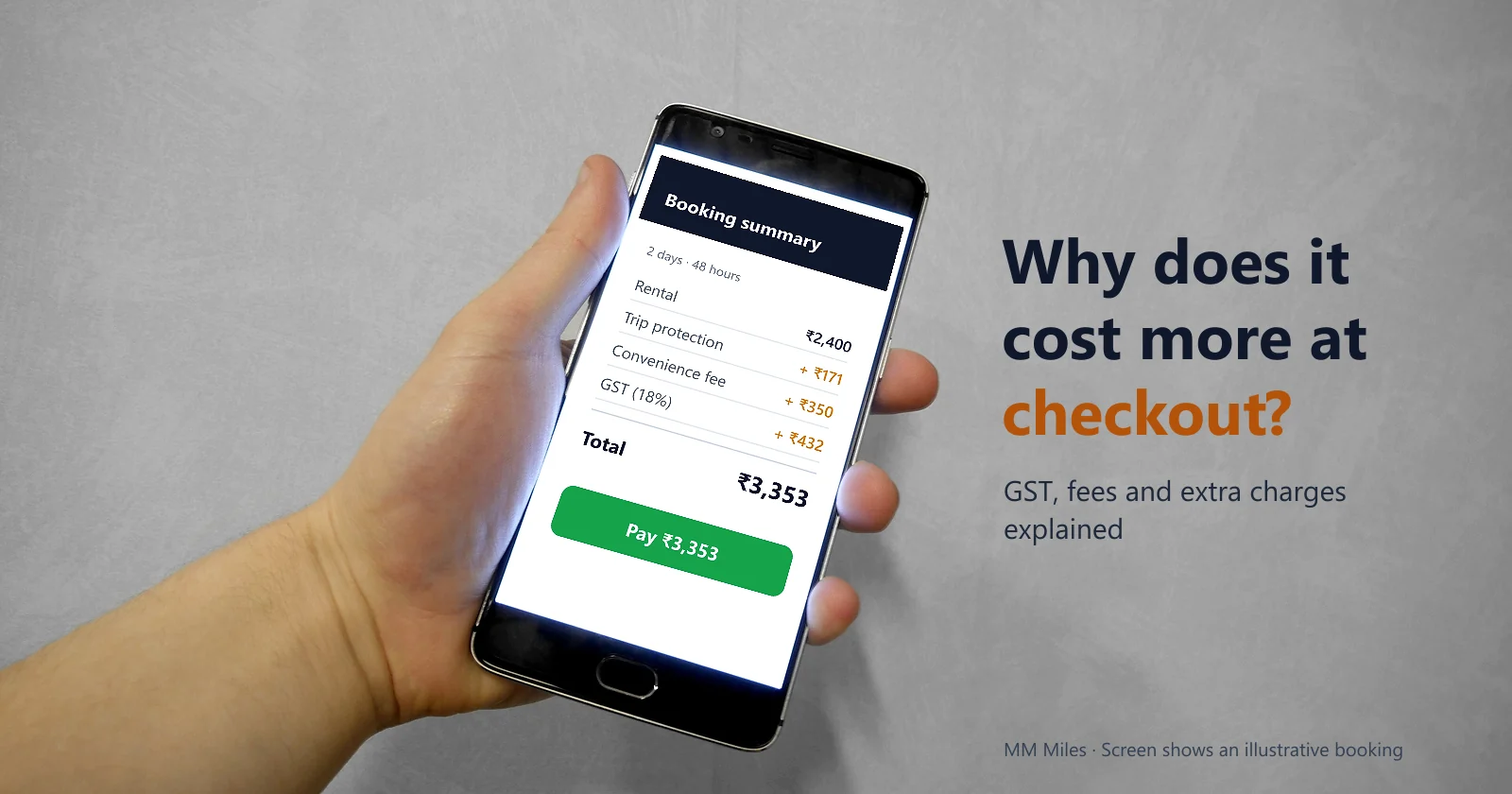
If you have ever wondered why your car rental booking costs more at checkout than the price on the search page, you are not imagining it. You pick a car at ₹50 an hour, multiply it by 48 hours, expect ₹2,400 — and the payment page asks for ₹3,353. Nothing has gone wrong. On most self drive platforms in India, the price you see first is only the rental part of the bill. GST, a convenience fee and trip protection are added as you go through checkout, and some charges only appear after the trip. This guide explains every one of those charges, which ones are normal, which ones you can reduce, and the five questions to ask before you pay — so you can compare platforms on the number that actually matters: the final total.
A Real Checkout, Line by Line
Here is how a typical two-day self drive booking builds up — the same breakdown shown in the cover image of this post. The car is listed at ₹1,200 a day, which works out to ₹50 an hour.
| Line on the bill | Amount | What it is |
|---|---|---|
| Rental: ₹50/hr × 48 hours | ₹2,400 | The price you saw on the search page |
| Trip protection | ₹171 | Covers part of your liability if the car is damaged |
| Convenience fee | ₹350 | Booking, handover and platform costs |
| GST at 18% on the rental | ₹432 | Government tax on the rental amount |
| Total you pay | ₹3,353 | About 40% more than the listed price |
None of these charges is unusual — almost every platform in India has some version of each. The problem is when you compare one platform's headline rate against another's final total. A car listed at ₹45/hr with fees added later can easily cost more than one listed at ₹55/hr with fees already included.
The 9 Charges That Change Your Price
1. GST — usually 18%
Self drive car rental in India is usually taxed at 18% GST on the rental amount. Some platforms show prices including GST; many show the pre-tax rate and add GST on the payment page. On a ₹2,400 rental, that is ₹432 — the single biggest addition on most bills. When you compare platforms, check whether each rate is before or after tax.
2. Convenience or platform fee
Most platforms add a fixed convenience, booking or platform fee to cover payments, verification, handover and support. It is usually a flat amount per booking, so it matters more on short trips: ₹300 on a ₹1,000 booking is a 30% increase, while on a week-long rental it hardly shows. Some platforms raise the fee for longer bookings.
3. Trip protection or damage waiver
Every self drive car has insurance, but the insurance does not cover everything — and the customer is usually liable for part of any damage. Trip protection (also called a damage waiver or protection plan) limits how much you pay if something happens. It may be included automatically or offered in tiers. Before you book, check what the plan covers, what the maximum you could pay after an accident is, and what is excluded — tyres, glass, the underbody and damage from driving through water are common exclusions. Our car rental accident insurance guide explains this in detail.
4. Short-booking pricing
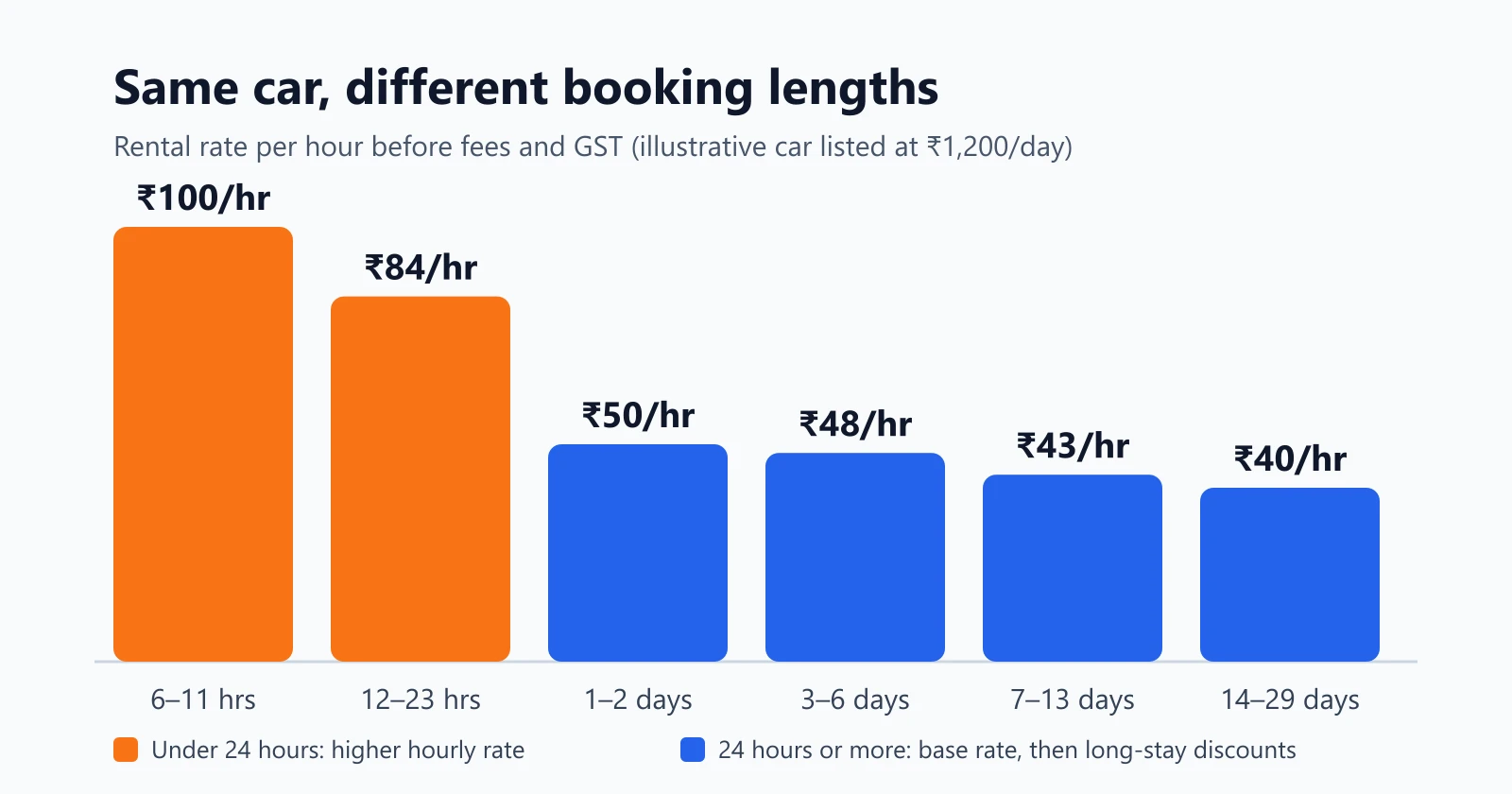
This is the charge that surprises people most, because it does not appear as a separate line — it is built into the hourly rate. A car has the same fixed costs for every trip: cleaning, inspection, handover, and the hours it sits idle waiting for the next customer. On a 6-hour booking those costs are spread over very few hours, so the hourly rate is higher. On many platforms the rate for bookings under 24 hours is 60 to 100% above the daily rate, and bookings of three days or more get a discount.
If you need a car for 18 or 20 hours, check the price for a full 24. Because the hourly rate drops at the 24-hour mark, a full day can cost about the same — or even less — than a shorter booking, and you get the extra hours free.
5. Weekend, holiday and demand pricing
Some platforms raise prices on weekends, long weekends and festival dates, or adjust them automatically by demand. If you search on a Tuesday for a Saturday trip, the rate may already be higher than a weekday booking. Compare prices for your actual dates, not the starting rate on the homepage.
6. Security deposit
Many platforms block a refundable security deposit — commonly ₹2,000 to ₹10,000 or more — on your card or account at pickup. You get it back after the trip, minus any charges. It is not a cost if it all comes back, but it does tie up your money, and refunds can take days or weeks. Check the amount, the refund timeline and exactly what can be deducted.
7. Delivery and pickup charges
Doorstep delivery is convenient, but some platforms charge for it — especially for distant areas, airports, or late-night handovers. Check whether delivery is free for your address and time before you choose it, and whether collecting the car from a hub is cheaper.
8. Km limits and fuel policy
Some plans include a fixed number of kilometres per day and charge per km beyond that. On a road trip that can add more than every other fee combined. Check the km allowance and the per-km rate before you book a long drive. Fuel works the same way: most self drive cars follow a same-to-same policy, and returning the car with less fuel than you received usually means a refuelling charge on top of the fuel itself.
9. Charges that arrive after the trip
- Late return: charged by the hour, sometimes at a higher rate than the booking.
- Extra cleaning: for sand, pet hair, food stains or smoking.
- Tolls: if the car's FASTag was used, the toll amounts are usually billed to you after the trip.
- Traffic challans: speeding or signal fines issued during your trip can reach the owner weeks later and are passed on to you.
- Damage: anything not covered by your trip protection, assessed after the car is inspected.
Take photos and a short video of the car — all four sides, the interior, the odometer and the fuel gauge — at pickup and again at return. It takes two minutes and is the best protection against disputes over damage, fuel or cleaning charges.
Drip Pricing: What the Rules Say
Showing a low price first and adding the rest of the cost later has a name: drip pricing. India's Central Consumer Protection Authority lists drip pricing as one of the dark patterns in its Guidelines for Prevention and Regulation of Dark Patterns, 2023 — describing it as not revealing price elements upfront, revealing them surreptitiously during the purchase, or revealing the price only after the purchase is confirmed. For you as a customer, the practical lesson is the same whatever any platform does: never decide on the headline rate. Decide on the final total.
5 Questions to Ask Before You Pay
| Question | Why it matters |
|---|---|
| What is the final total for my exact dates? | The only number worth comparing between platforms |
| Is GST included in that total? | Adds 18% to the rental if it is not |
| What does trip protection cover, and what is my maximum liability? | Decides what an accident could cost you |
| Is there a deposit, how much, and when is it refunded? | Your money may be blocked for weeks |
| Is there a km limit, and what are the late-return and fuel charges? | These are the charges that arrive after the trip |
How to Pay Less for the Same Car
- Book for 24 hours or more where you can — the hourly rate is usually much lower than for short bookings.
- Book longer trips in one go. Three days or a week is usually cheaper per hour than separate shorter bookings.
- Look for coupons on the checkout page before you pay.
- Choose the right car size. A hatchback or compact SUV costs less to rent and to fuel than a 7-seater you do not need.
- Book early for weekends and festivals, before demand-based prices rise and the cheaper cars are taken.
- Return on time, with the agreed fuel, and with the car reasonably clean — that avoids most post-trip charges.
How MM Miles Shows Your Price
On MM Miles, the booking summary at checkout lists every line before you pay: the rental for your exact hours, trip protection, the convenience fee and GST, with any coupon discount applied — and the total you see is the amount you are charged. Bookings of 24 hours or more get the base rate, and longer bookings get a lower hourly rate automatically, up to 20% off for rentals of two weeks or more. If anything on the summary is unclear, ask our support team before you pay.
A low-cost, fuel-efficient choice for city errands and short trips — the easiest way to keep the total down.
View Maruti Fronx →The best value for a full-day or weekend booking for five, where the lower per-hour rate for longer rentals adds up.
View Hyundai Creta →See the full breakdown — rental, trip protection, convenience fee and GST — before you pay. Pick your dates and check the final total on MM Miles.
Check Your Total Price →Cover photo: based on "Hand holding smartphone with blank white screen" by Santeri Viinamäki / Wikimedia Commons, CC BY-SA 4.0, with an illustrative booking screen added.