Self drive car rental in India sits at the intersection of three regulatory frameworks — the Motor Vehicles Act 1988, the Rent-a-Cab Scheme 1989 and state-specific RTO (Regional Transport Office) regulations. Most renters never think about this until they are stopped at a checkpost on NH44 outside Krishnagiri or at the Karnataka-Tamil Nadu border on NH275, and a traffic officer asks for documents that neither they nor the rental company prepared them for. In 2025 and 2026 this got significantly more complex — Karnataka introduced a digital permit verification portal linked to Vahan 4.0, Tamil Nadu tightened compliance for commercial rentals, and the Motor Vehicles Amendment Act 2019 penalties that seemed theoretical are now being actively enforced on national highways. This is the complete guide — what the law actually says, what documents are required, what traffic fines apply to rental car drivers, and how MM Miles ensures full compliance so you never face a checkpost problem.
The Legal Framework — 3 Laws Every Renter Should Know
1. The Motor Vehicles Act 1988 — The Foundation
The Motor Vehicles Act 1988, administered by the Ministry of Road Transport and Highways (MoRTH), is the primary legislation governing all road vehicles and their operators in India. The Act covers licensing of drivers, registration of motor vehicles, control through permits, traffic regulation, insurance, liability, offences and penalties. For self drive car rental specifically, the most relevant provisions are Section 88 (tourist permits for vehicles crossing state boundaries), Section 39 (registration requirements for motor vehicles used commercially), and Section 147 (mandatory insurance requirements). The Motor Vehicles Amendment Act 2019 significantly increased penalties for traffic violations — fines that previously seemed minor are now substantial and actively enforced.
2. The Rent-a-Cab Scheme 1989 — The Rental Operator Framework
The Rent-a-Cab Scheme 1989, enacted under the Motor Vehicles Act, is the specific legal framework for self drive car rental operators in India. It sets the operational rules: operators must hold a valid licence under the scheme, vehicles must be commercially registered (yellow number plate or HSRP compliant commercial marking), tourist permits under Section 88 must be obtained for inter-state travel, fitness certificates must be current, and minimum fleet size requirements typically apply. This is the scheme that distinguishes legal rental operators from grey-market operators using privately registered white-board vehicles.
The significance for renters: when you rent from an operator licensed under the Rent-a-Cab Scheme, the vehicle is legally authorised for rental use, the insurance is valid for commercial rental operations, and you are protected under the Consumer Protection Act 2019 for any service failures. When you rent from an unlicensed operator or a private individual listing their white-board car on a marketplace — even via a large platform — the legal protections are significantly reduced and the insurance validity is questionable.
3. State RTO Regulations — What Changed in 2025-2026
State-level RTO regulations have tightened significantly in 2025 and 2026. Karnataka introduced a digital permit verification portal linked to the Vahan 4.0 database — every self drive vehicle must now display digital proof of commercial registration to avoid on-road disputes. RTOs have mandated quarterly audits for licensed rental companies. Tamil Nadu is implementing similar digital compliance requirements through the Tamil Nadu Transport Department's electronic monitoring systems. Kerala is piloting an online e-Rent Vehicle Registry combining operator licensing, driver verification and insurance validation — a model the Ministry of Road Transport and Highways is considering for national rollout.
Documents Required — Renter and Vehicle
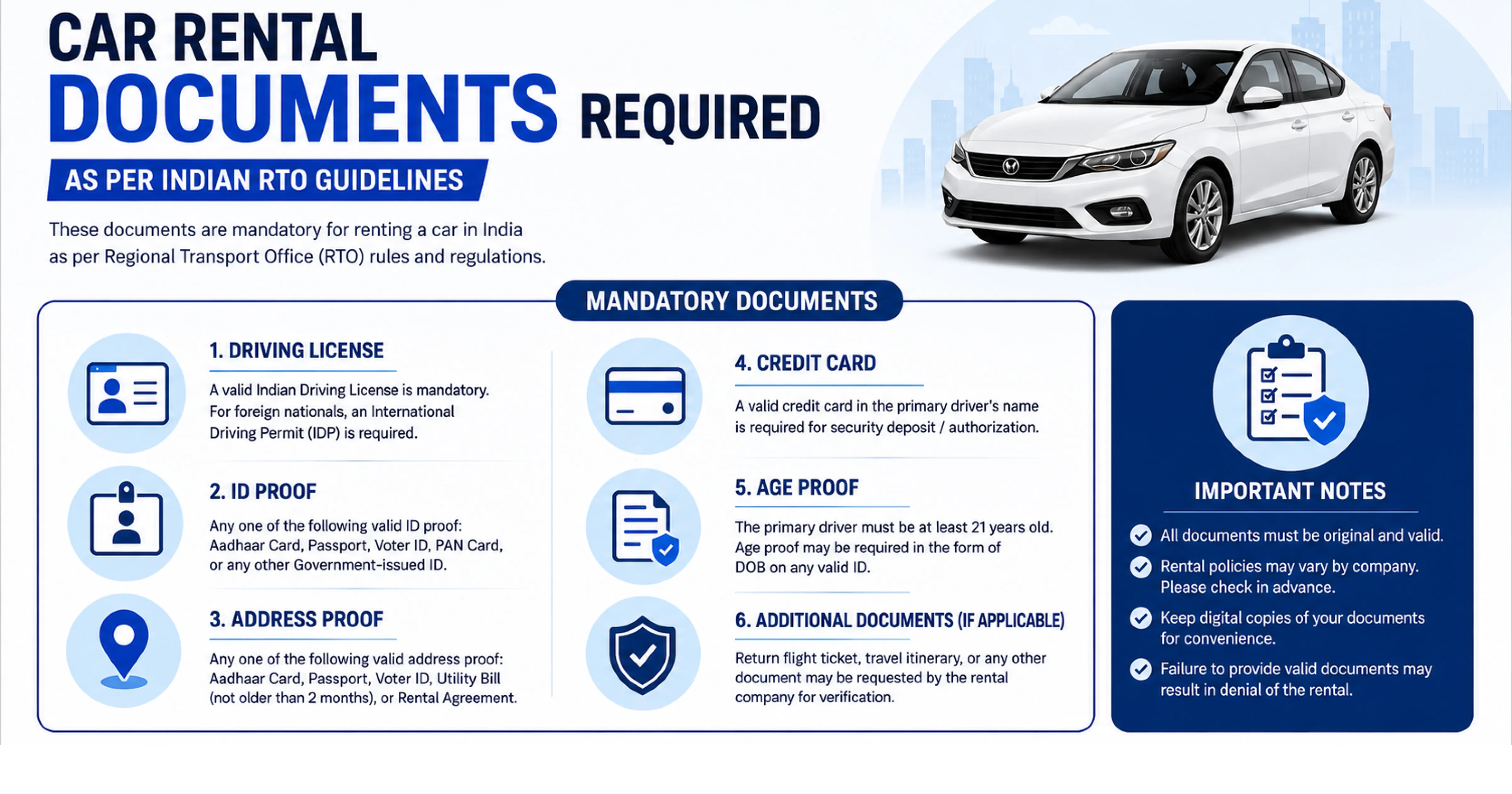
Two sets of documents matter for a self drive rental: what the renter must carry and what the vehicle must carry. Understanding both protects you at checkposts and in any traffic dispute.
| Document | Required by | Provided by | Penalty if missing |
|---|---|---|---|
| Valid driving licence | Renter | Renter | ₹5,000 fine + vehicle seizure risk |
| Government ID (Aadhaar/PAN) | Renter | Renter | Identity verification issue |
| RC Book (Registration Certificate) | Vehicle | MM Miles | ₹5,000 fine |
| Comprehensive motor insurance | Vehicle | MM Miles | ₹4,000 fine (third party minimum) |
| Pollution Under Control (PUC) certificate | Vehicle | MM Miles | ₹1,000 fine + vehicle detention |
| Fitness certificate | Vehicle (commercial) | MM Miles | Vehicle may be seized |
| Tourist permit (Section 88 MV Act) | Vehicle (inter-state) | MM Miles | Vehicle detained at state border |
| Rental agreement copy | Renter | MM Miles at delivery | Evidence in dispute |
MM Miles provides all vehicle documents at delivery — RC book copy, insurance certificate, PUC certificate, fitness certificate and tourist permit are included with every rental. The renter only needs their driving licence and Aadhaar. Before any inter-state drive — Chennai to Bangalore, Coimbatore to Munnar — confirm with MM Miles that the tourist permit covers the destination state.
Traffic Fines Under the Motor Vehicles Amendment Act 2019 — Updated 2026
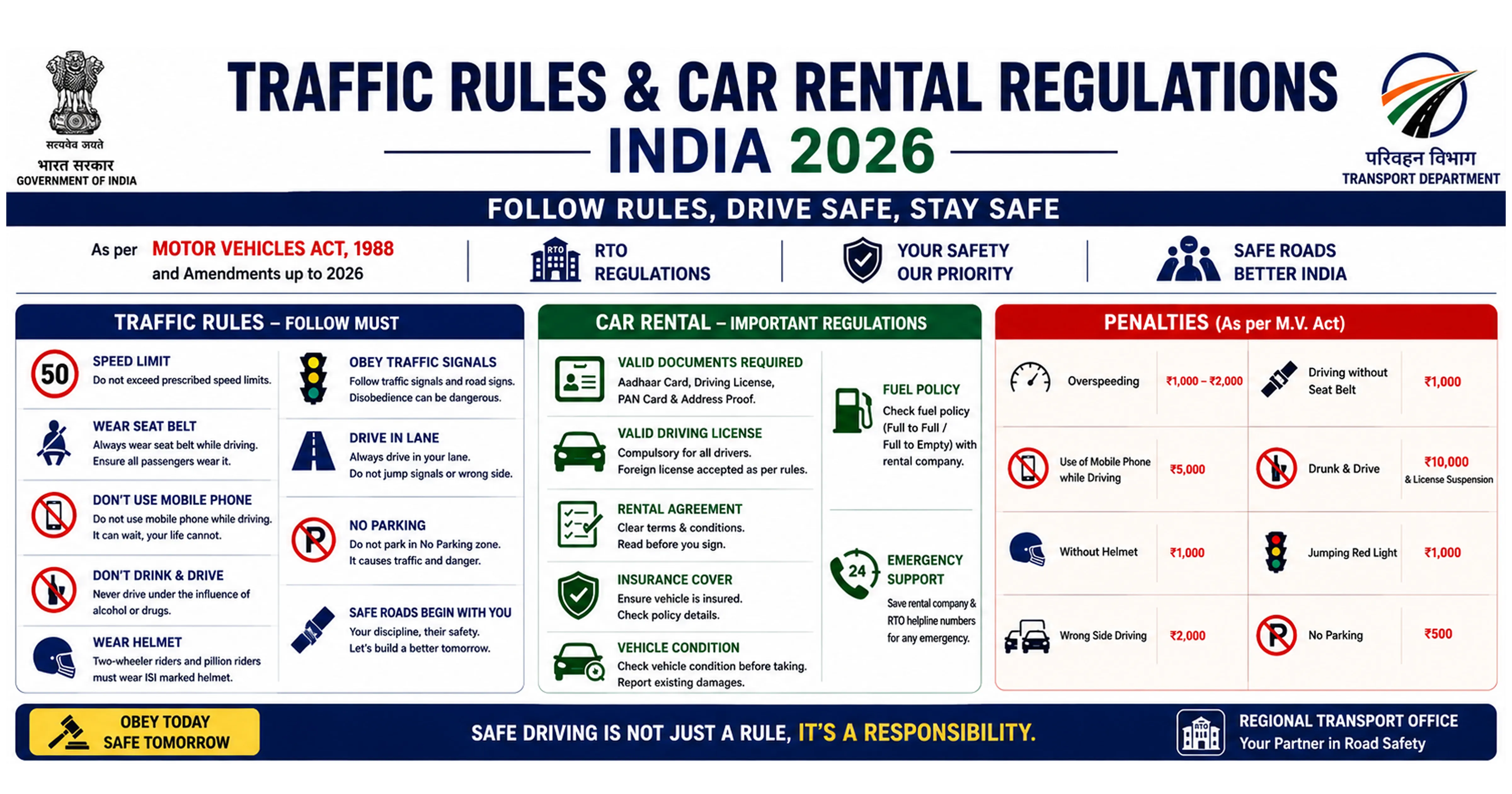
The Motor Vehicles Amendment Act 2019 significantly increased penalties for traffic violations. These fines apply equally to rental car drivers — being in a rental does not reduce your liability. Here are the key fines enforced on national highways in Tamil Nadu and Karnataka in 2026:
| Violation | Fine (first offence) | Fine (repeat) | Additional consequence |
|---|---|---|---|
| Driving without valid licence | ₹5,000 | ₹10,000 | Vehicle seizure possible |
| Over-speeding (car) | ₹1,000-₹2,000 | ₹2,000 | Licence suspension possible |
| Using mobile while driving | ₹1,000 | ₹10,000 | Licence suspension 3 months |
| Not wearing seatbelt (front) | ₹1,000 | ₹1,000 | Compoundable offence |
| Not wearing seatbelt (rear) | ₹1,000 | ₹1,000 | Enforced on NH44, NH275 |
| Drunk driving | ₹10,000 | ₹15,000 | Up to 6 months imprisonment |
| Jumping red light | ₹1,000-₹5,000 | ₹5,000 | Licence suspension possible |
| Driving without insurance | ₹2,000 | ₹4,000 | Vehicle seizure |
| No PUC certificate | ₹1,000 | ₹1,000 | Vehicle detained |
| Wrong side driving | ₹1,000-₹5,000 | ₹10,000 | Serious safety violation |
| No seatbelt for children under 14 | ₹1,000 | ₹1,000 | Plus crash helmet rule |
| Overloading passengers | ₹1,000 per passenger | ₹1,000 per passenger | Vehicle detained |
Traffic challans issued during a rental period are the renter's responsibility — not the rental company's. The challan is registered against the vehicle and the driver's licence. Pay all challans promptly via the Parivahan Sewa portal at parivahan.gov.in. Unpaid challans can affect vehicle compliance status and may impact future rental eligibility.
Speed Limits — National Highways and State Roads
| Road type | Car speed limit | Enforced by | Camera locations |
|---|---|---|---|
| National Highway (4-lane) | 100 kmph | Traffic Police + NHAI cameras | Every 30-40 km on NH44, NH275 |
| State Highway | 80 kmph | State Traffic Police | At town entry/exit |
| City/urban road | 50-60 kmph | City Traffic Police | Major junctions |
| Ghat road (all states) | 30-40 kmph | Forest Dept + Traffic Police | Active near hairpin bends |
| School/hospital zone | 25 kmph | Local Traffic Police | School hours enforced |
| Within wildlife reserve | 40 kmph | Forest Department | Cameras active in Bandipur, Nagarhole |
Speed cameras on NH44 (Chennai-Salem-Coimbatore corridor) and NH275 (Bangalore-Mysore Expressway) are active and issue automated challans linked to the vehicle's registration in the Vahan database. Speed camera challans are sent to the registered owner of the vehicle — for rental cars, MM Miles receives the camera notice and passes the challan to the renter who was driving at the time. Always drive within speed limits on national highways — automated enforcement is systematic and consistent.
Inter-State Travel — Permits and Checkposts
Driving a rental car across state borders requires the vehicle to hold a valid All-India Tourist Permit issued under Section 88 of the Motor Vehicles Act. This permit allows commercial vehicles to operate across state borders. Without it, the vehicle can be detained at state border checkposts.
Common inter-state routes from South India and the checkposts to know:
- Chennai to Bangalore via NH44: Tamil Nadu-Karnataka border checkpost at Hosur — vehicle documents verified, tourist permit checked
- Coimbatore to Munnar via Palakkad: Tamil Nadu-Kerala border checkpost at Walayar — tourist permit and insurance verified
- Bangalore to Ooty via Bandipur: Karnataka Forest Department checkpost at Gundlupet (forest entry) and Tamil Nadu Forest Department checkpost at Mudumalai exit — RC, insurance and driving licence verified
- Mysore to Wayanad: Karnataka-Kerala border at Sultan Bathery — tourist permit required
- Chennai to Pondicherry: Tamil Nadu-Puducherry UT border — no separate permit needed, Puducherry is Union Territory but Tamil Nadu tourist permit covers entry
MM Miles provides All-India Tourist Permits on all vehicles covering Tamil Nadu, Karnataka, Kerala and other states. Before any cross-state drive, confirm the destination state is covered in your rental agreement. If driving to Goa or Maharashtra from South India, additional permit verification may be needed — confirm with MM Miles at booking.
How MM Miles Ensures Full Legal Compliance
MM Miles operates under the Rent-a-Cab Scheme 1989 with all vehicles commercially registered and compliant with Motor Vehicles Act requirements. Here is what MM Miles handles so renters never face compliance issues at checkposts:
- All vehicles registered commercially under Rent-a-Cab Scheme 1989 — no white-board private cars in the fleet
- Valid All-India Tourist Permit under Section 88 MV Act on all vehicles — inter-state travel covered
- Comprehensive motor insurance covering commercial rental use — personal insurance void clauses do not apply
- Valid PUC certificates maintained — checked before every rental
- Fitness certificates current on all commercial vehicles — RTO compliance maintained
- Karnataka Vahan 4.0 digital permit verification compliant — vehicles display digital proof of commercial registration
- All vehicles 2020 model year onwards — fitness certificate renewal is straightforward for newer vehicles
- GPS tracking on all fleet vehicles — compliant with Karnataka RTO quarterly audit requirements
- Pre-delivery document check at every rental — renter's driving licence validity confirmed before handover

Key Traffic Rules Every Rental Car Driver Must Follow
- Always carry your driving licence — not a photocopy, the physical licence or mDrive app digital licence accepted in Tamil Nadu and Karnataka
- Seatbelt for all occupants including rear passengers — enforced on all national highways and increasingly in cities
- Never use mobile phone while driving — ₹10,000 fine for repeat offence, 3-month licence suspension
- Headlights on at all times in tunnels, during rain and on all ghat roads regardless of time
- Honk before every blind corner on ghat roads — legally required under Tamil Nadu and Karnataka Motor Vehicles Rules
- Zero alcohol tolerance at checkposts — blood alcohol content above 30 mg/100 ml is an offence. Breathalyser tests at NH44 and NH275 checkposts are routine on weekends
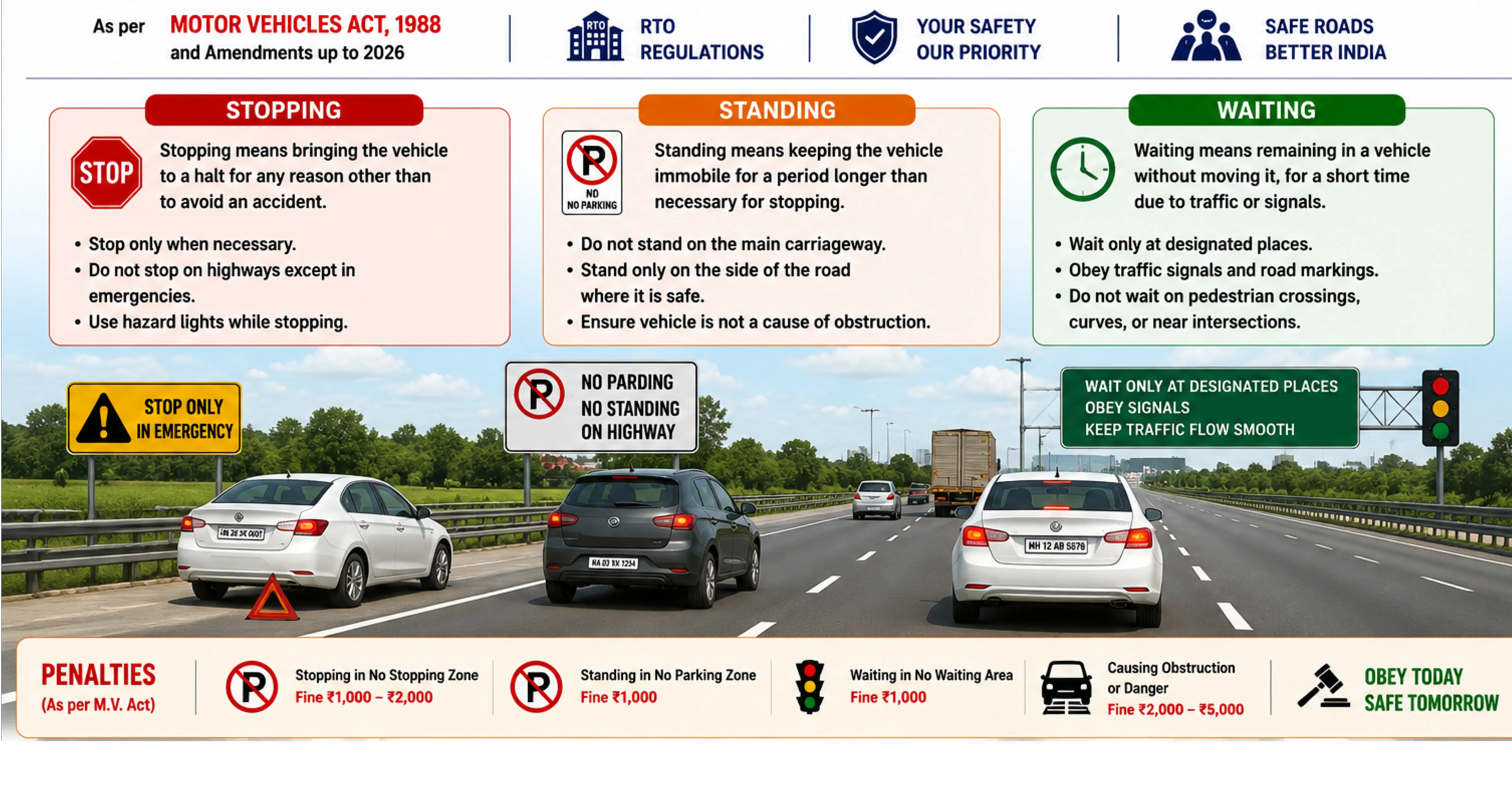
- Do not stop on national highway lanes — use designated rest areas for breaks, fuel stops and photography
- No overtaking on blind curves or hills — visible road markings indicate no-overtaking zones on all national highways
- Speed limit in wildlife reserves is 40 kmph — strictly enforced at Bandipur, Mudumalai, Nagarhole and Valparai checkposts
- All children under 14 must use proper restraints — child seat or seatbelt as appropriate
What to Do If You Are Stopped at a Checkpost
Being stopped at a state border checkpost or a highway traffic check is a normal part of driving in India — not a cause for anxiety if documents are in order. Here is the correct procedure:
- Stop immediately and fully at the checkpost — do not slow down and continue
- Switch off the engine and stay in the vehicle unless asked to step out
- Have ready: your driving licence, vehicle RC book copy, insurance certificate and tourist permit — MM Miles provides all of these in the document folder in the glovebox
- If asked about the rental, explain it is a commercial rental from MM Miles under the Rent-a-Cab Scheme — the tourist permit confirms this
- If a challan is issued for a traffic violation, accept it, note the challan number and pay via parivahan.gov.in within 60 days
- Do not argue about challans at the checkpost — the correct remedy is an appeal through the Motor Accidents Claims Tribunal if you believe the challan was wrongly issued
- Call MM Miles 24/7 support immediately if there is any document dispute — the team can provide additional vehicle compliance documentation
For official traffic violation challan payment visit the Parivahan Sewa portal at parivahan.gov.in operated by the Ministry of Road Transport and Highways. For driving licence related queries visit the Sarathi portal at sarathi.parivahan.gov.in. For vehicle registration and permit status verification visit the Vahan portal at vahan.parivahan.gov.in. For consumer complaints against rental companies visit the National Consumer Helpline at consumerhelpline.gov.in.
Rent a fully compliant self drive car in Chennai — all documents provided, commercial registration, tourist permit, comprehensive insurance. Zero compliance risk at any checkpost.
Book Compliant Self Drive in Chennai →Bangalore self drive with complete RTO compliance — Vahan 4.0 verified, Rent-a-Cab Scheme licensed, inter-state tourist permit included. Zero deposit, home delivery.
Book Compliant Self Drive in Bangalore →