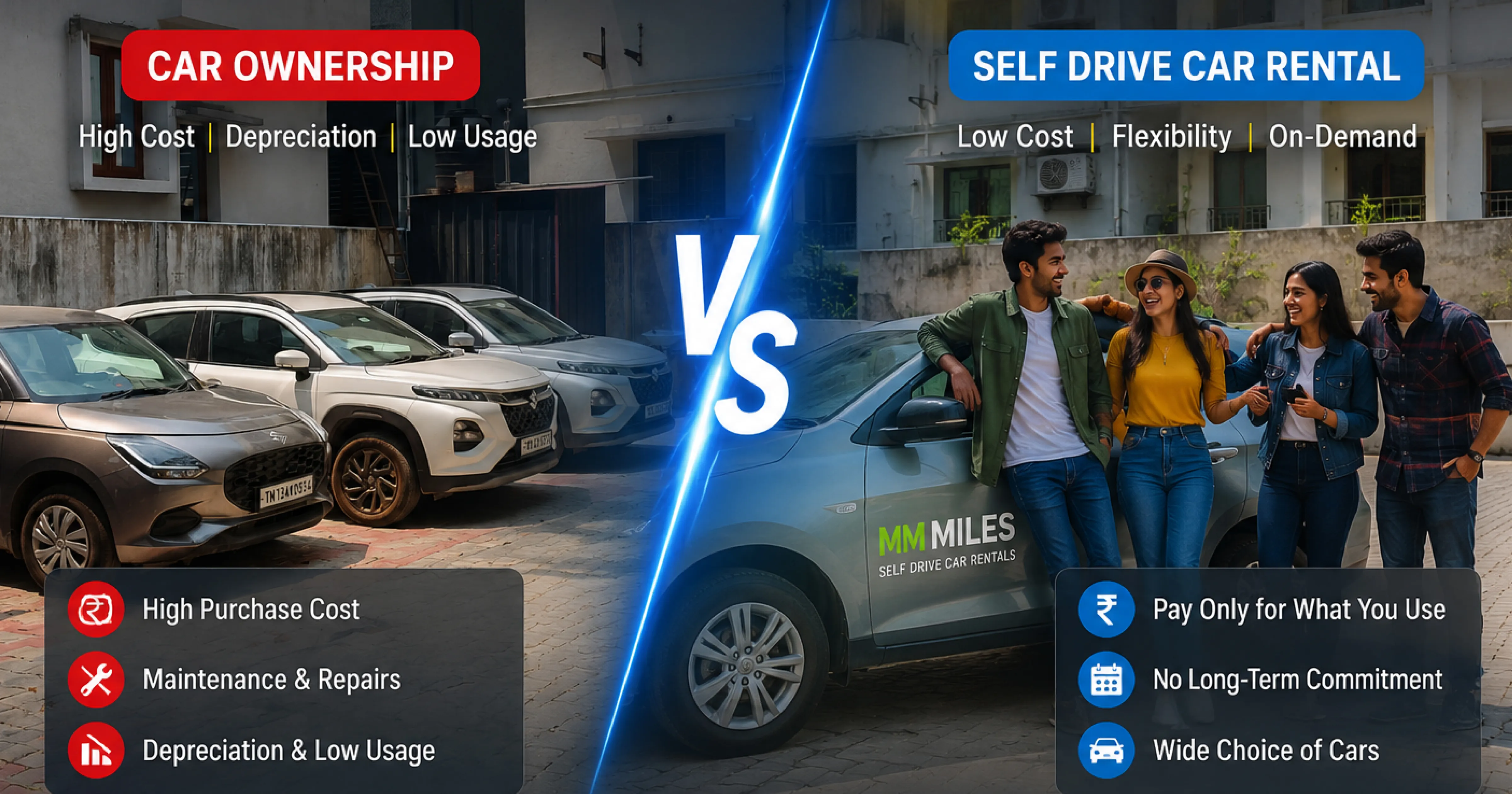
Something is shifting in how urban India thinks about cars. Not slowly - fast. The generation that watched their parents save for five years to buy a Maruti 800 is now choosing differently. They are renting instead of buying. Driving instead of owning. Paying for usage instead of paying for an asset that sits in a parking lot 18 hours a day. The numbers behind this shift are significant: India's car rental market was valued at USD 3.10 billion in 2025. It is projected to reach USD 10.16 billion by 2035 — a 12.60% compound annual growth rate that makes it one of the fastest-growing mobility markets in Asia. The self drive segment specifically is growing at 7.92% CAGR. Online bookings now control 66.85% of all car rental transactions in India. This is not a trend. It is a structural shift in how one of the world's largest consumer markets thinks about personal mobility. This guide covers everything — the market data, the financial case, the lifestyle logic and why MM Miles is at the centre of this revolution in South India.
The Data - What India's Car Rental Market Actually Looks Like
The India car rental market was valued at USD 3.10 billion in 2025 according to Expert Market Research. By 2034 it is projected to reach USD 10.03 billion at a CAGR of 13.78%. IMARC Group's 2026 analysis puts the 2025 valuation at USD 3,139.6 million with a path to USD 10,029.9 million by 2034. The convergence across multiple research firms on the USD 3.1 billion 2025 valuation and USD 10 billion 2034-2035 projection reflects genuine underlying demand, not optimistic forecasting.
The breakdown by segment reveals exactly where growth is concentrated. Economy and budget cars control 71.88% of the market - exactly where MM Miles operates at ₹799/day. Leisure and tourism account for 57.74% of bookings - road trips from Chennai to Pondicherry, from Bangalore to Coorg, from Coimbatore to Ooty. Online bookings have crossed the two-thirds threshold at 66.85% - confirming that the smartphone-first booking model MM Miles uses is aligned with where the market is going. The self drive segment specifically is posted to grow at 7.92% CAGR during 2026-2031. This is the segment where MM Miles competes - and it is the segment growing fastest.
| Market metric | 2025 value | Projected value | CAGR |
|---|---|---|---|
| India car rental market total | USD 3.10B | USD 10.16B (2035) | 12.60% |
| Self drive segment | USD ~0.93B | Growing at 7.92% | 7.92% (2026-2031) |
| Online bookings share | 66.85% | Growing | 7.60% |
| Economy/budget segment | 71.88% share | Dominant | Fastest growing |
| Global self drive market | USD 25.5B (2024) | USD 76.5B (2030) | 20.1% |
Why This Is Happening - The 5 Forces Behind India's Self Drive Revolution
Force 1 - The Millennials and Gen Z Ownership Calculation
The 25-35 age cohort that is now the largest segment of India's urban workforce is making a different calculation than their parents did. Their parents bought a Maruti or a Hyundai as a symbol of arrival — an asset that represented stability. The current generation runs the actual numbers and finds that in cities like Chennai and Bangalore, car ownership is economically irrational for most usage patterns. Self drive rental choices are gradually replacing traditional chauffeur-driven models, mostly serving millennials and young working professionals who value privacy, freedom and flexible travel schedules, according to market research from the India car rental market report by Research and Markets. This is not anti-ownership sentiment — it is a rational economic decision when you run the real monthly cost comparison.
Force 2 - Smartphone Penetration Above 80% Among Urban Adults
The infrastructure that makes self drive rental convenient did not exist five years ago. Smartphone penetration surpassing 80% among urban adults has pushed online bookings above two-thirds of all reservations according to Mordor Intelligence's 2026 India car rental analysis. The ability to book a car, verify documents digitally, receive home delivery and return without visiting a hub — all via a phone — removes the friction that historically kept people in the cab-dependent model. When booking a self drive car is as easy as booking an Ola, the financial advantage of self drive over cabs becomes the deciding factor.
Force 3 - Urban Parking and Ownership Infrastructure Costs
Owning a car in Chennai or Bangalore involves costs that depreciation calculators miss. Apartment parking in Koramangala or Velachery costs ₹1,500-3,000 per month if allocated, or the car parks on the street with associated scratch risk. Office parking in most Bangalore IT campuses is either paid or lottery-based. MG Road and Indiranagar parking is chronically undersupplied. A car that cannot be parked conveniently near where you live and work is a different kind of asset from a car that can. Self drive rental eliminates the parking cost and parking problem simultaneously — the car is at your door when needed and gone when not needed.
Force 4 - The Road Trip Culture Surge
Leisure and tourism account for 57.74% of India's car rental market. The road trip culture that emerged strongly post-2021 has not retreated - it has consolidated into a permanent behavioural shift. Chennai to Pondicherry on ECR. Bangalore to Coorg through coffee estates. Coimbatore to Ooty as a day trip. Mysore to Nagarhole for a wildlife morning. These routes are being driven by more people every year and most of them are renting rather than using their personal cars — because rental means unlimited km, full insurance, and no service schedule anxiety on a ghat road 400 km from home.
Force 5 - The EV Transition Making Ownership More Complex
India's push toward electric vehicle adoption - the PM E-DRIVE scheme under the Ministry of Heavy Industries and the FAME II policy - is creating an interesting ownership uncertainty. A petrol car bought today will face resale headwinds as EV adoption accelerates. An EV bought today requires home charging infrastructure that many apartment dwellers do not have access to. The ownership calculus is more complex than it was in 2018. Self drive rental sidesteps this entirely - you rent the right car for the occasion without committing to a technology platform that may change significantly in 3-5 years.
The Real Cost of Car Ownership in Chennai and Bangalore - 2026 Numbers
This is the calculation most car purchase decisions skip. Here are the real monthly costs of owning a Hyundai Creta in Chennai or Bangalore in 2026:
| Cost component | Monthly amount | Notes |
|---|---|---|
| EMI (₹12L, 5-year loan, 10% down) | ₹18,000–₹22,000 | Varies by bank rate |
| Comprehensive insurance (annual ÷ 12) | ₹4,500–₹6,000 | Declines with age, IDV reduces |
| Fuel (1,500 km/mo, ₹103/L, 15 kmpl) | ₹10,300 | Varies with usage |
| Servicing and maintenance average | ₹2,500–₹4,000 | Higher in first 2 years |
| Parking (apartment + occasional paid) | ₹1,500–₹3,000 | Higher in Koramangala, MG Road |
| Tyres, battery, misc replacements (annual ÷ 12) | ₹1,000–₹2,000 | Accumulates over 3 years |
| Total monthly cost of Creta ownership | ₹37,800–₹47,300 | Before depreciation |
| Annual depreciation Year 1 (15-20% of ₹12L) | ₹15,000–₹20,000/mo | ₹1.8L-₹2.4L per year |
Including depreciation - which is a real financial loss even if it does not appear as a monthly payment - owning a Hyundai Creta costs ₹52,800-₹67,300 per month in the first year. MM Miles monthly rental of the same car: ₹22,999. The gap is not small. It is ₹29,801-₹44,301 per month in Year 1 alone. Over 3 years, the financial advantage of monthly rental over ownership is ₹10.73 lakh to ₹15.95 lakh on a single Creta. This is the calculation that is driving India's self drive revolution from an individual financial decision level — before even considering the market-level forces.
The depreciation calculation is the one most people miss. A new Hyundai Creta worth ₹12 lakh loses ₹1.8-2.4 lakh in value in the first year regardless of how carefully you drive it. This loss belongs entirely to the car owner. On a monthly rental it belongs to MM Miles. You pay for usage, not for depreciation.
The Self Drive Experience - What Changes When You Rent Instead of Own
The financial case is clear. But the lifestyle case is equally important for understanding why this shift is happening and why it is irreversible.
1. Right car for the right occasion
A car owner in Koramangala owns one car. On Tuesday they commute to Whitefield - the Creta is fine. On Saturday they are driving to Coorg with 6 people — they wish they had a Fortuner. On Sunday they are doing a quick Nandi Hills sunrise run — they wish they had a light hatchback for the hill roads. The car you own is the car you have for every occasion. Self drive rental means you pick the right car for each trip. Monthly rental of a Creta for daily use, plus a Fortuner booked for the Coorg weekend. The flexibility of matching the vehicle to the need is something car ownership fundamentally cannot offer.
2. No maintenance anxiety on road trips
Every car owner who has driven a long road trip knows the background anxiety - is the service due? Are the tyres okay for 600 km of ghat roads? When did I last check the brake fluid? A rental car from MM Miles comes pre-inspected. The brakes have been checked. The tyres are within specification. The service is current. The comprehensive insurance is active. You get in at Anna Nagar, set the destination to Ooty and drive without that background worry. The maintenance anxiety belongs to MM Miles. Your job is to drive.
3. No depreciation clock running
Every kilometre you drive your own car is a kilometre of depreciation. A car that has done 80,000 km sells for significantly less than one that has done 40,000 km. On a rental car the depreciation clock is running on MM Miles' balance sheet, not yours. You can drive Chennai to Ooty and back — 1,150 km — without thinking about what it does to your resale value. The unlimited km model is not just a price feature. It is a mental freedom that ownership cannot offer.
MM Miles — South India's Self Drive Answer
In a market dominated by peer-to-peer marketplace platforms with variable car quality and inconsistent pricing, MM Miles is built on a different model. Directly owned fleet. All cars 2020 model year or newer. Zero security deposit. Unlimited km. Flat pricing with no weekend surcharge. 24/7 roadside support. Home delivery and pickup from your door in Chennai, Bangalore, Coimbatore and Mysore. 98% delivery success rate backed by immediate fleet reallocation when a previous customer extends.
The pricing structure reflects the market reality clearly. Onroadz starts from ₹1,199/day in Chennai. Zoomcar starts from ₹999/day with dynamic weekend pricing. MyChoize starts from ₹1,099/day. MM Miles starts from ₹799/day — the same in Chennai, Bangalore, Coimbatore and Mysore, same on Saturday as Tuesday, same on Diwali weekend as a regular Monday. The 20% commission structure for hosts means more cars join the MM Miles fleet. The lower commission means lower prices for renters. The virtuous cycle that the USD 10 billion India car rental market is building on.
South India's Self Drive Map - Where MM Miles Serves
| City | Starting price | Best road trip | Distance |
|---|---|---|---|
| Chennai | ₹799/day | Pondicherry via ECR | 162 km |
| Bangalore | ₹799/day | Coorg via NH275 | 270 km |
| Coimbatore | ₹799/day | Ooty via NH181 | 86 km |
| Mysore | ₹799/day | Coorg via Kushalnagar | 120 km |
Chennai - India's Coastal Self Drive Capital
Chennai is the city where self drive culture in South India was born. The East Coast Road — built by the National Highways Authority of India — is 162 km of coastal highway to Pondicherry with the Bay of Bengal on the left the entire way. Mahabalipuram's UNESCO World Heritage Shore Temple at 58 km. Auroville at 152 km. The French Quarter at 162 km. No other South Indian city has a coastal highway of this quality so close to its population centre. Chennai self drive starts at ₹799/day with MM Miles — lower than every major competitor currently ranking in the Chennai market.
Bangalore - The Road Trip Capital of South India
Bangalore has the most diverse road trip portfolio of any South Indian city. NH275 is a 4-lane expressway to Mysore. From Mysore, Coorg is 120 km and Ooty via Bandipur Tiger Reserve is 125 km — both achievable in a single day from Bangalore with an early departure. Nandi Hills at 60 km is the fastest sunrise escape. Chikmagalur at 250 km is the coffee country alternative to Coorg. Every road trip from Bangalore passes through dramatically different landscape within 3-5 hours. This is why Bangalore has the highest self drive rental demand of any South Indian city — and why MM Miles at ₹799/day flat, same every day, is the rational choice for the city's 12 million residents.
Coimbatore - The Western Ghats Gateway
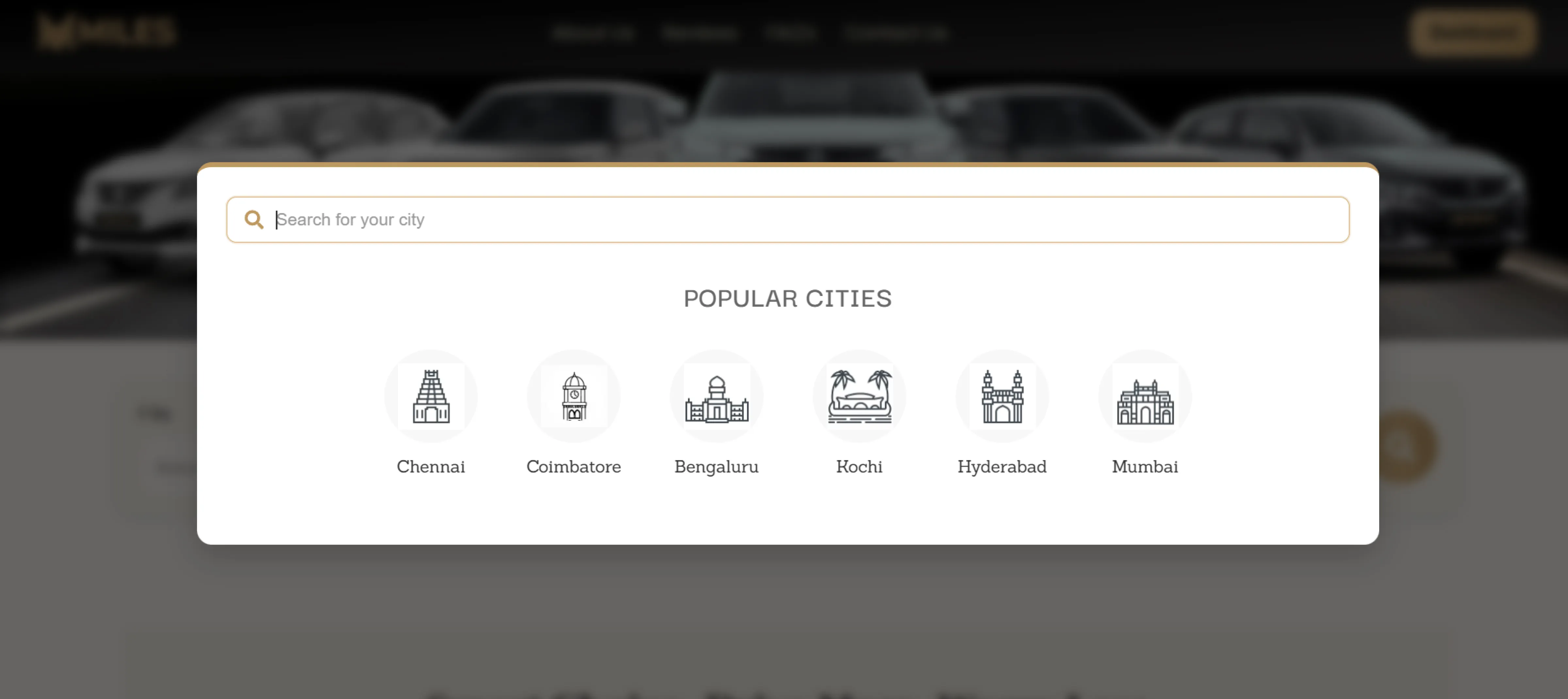
Coimbatore sits at the foot of the Nilgiri Hills - geographically the best-positioned South Indian city for Western Ghats access. Ooty is 86 km via NH181 and the Mettupalayam Ghat — a day trip. Valparai is 100 km via Pollachi through the Anamalai Tiger Reserve. Munnar is 150 km via Palakkad into Kerala. The Coimbatore International Airport (IATA: CJB) connects the city to major Indian cities, bringing in visitors who need a car for the Western Ghats destinations that Coimbatore accesses better than any other city. MM Miles serves all Coimbatore areas from Gandhipuram to Peelamedu.
Mysore - The Royal City at South India's Road Trip Crossroads
Mysore is the undiscovered self drive base of South India. Coorg at 120 km. Ooty at 125 km via Bandipur. Nagarhole National Park at 80 km. Wayanad at 140 km. The Amba Vilas Palace commissioned by Maharaja Krishnaraja Wadiyar IV. Chamundi Hills at 1,065 metres. Brindavan Gardens at the KRS Dam. Mysore offers both a destination and a base — you can spend a day in Mysore and then do a different road trip each morning for the next three days without ever repeating a route. MM Miles delivers across all Mysore areas from Vijayanagar to Gokulam.
The Revolution Is Not Coming - It Is Already Here
The India car rental market's trajectory from USD 3.10 billion in 2025 to USD 10.16 billion by 2035 is not a prediction about the future. It is an extrapolation of what is already happening. The millennials doing the ownership cost calculation. The Koramangala resident who did a monthly rental for 6 months and did not miss the EMI. The Chennai IT professional who discovered that the ECR to Pondicherry run in a rental Creta costs ₹799 plus fuel — and decided they did not need to own a car that spends 18 hours a day in a parking slot. The Coimbatore family that now does Ooty as a day trip three times a year rather than once as an owned-car trip.
The self drive revolution is not about people who cannot afford cars. India's economy is growing. Disposable incomes are rising. The USD 10 billion market by 2035 will be built by people who can afford cars and choose not to own them — because the numbers do not add up to ownership in a city where you live in a 1,200 sq ft apartment with one parking spot, work in an office 15 km away and want a weekend road trip once a month. For them — for the tens of millions of urban Indians in this exact situation — MM Miles at ₹799/day with zero deposit, unlimited km, new model cars and home delivery is the rational answer.
For market data on India's car rental industry visit the Ministry of Road Transport and Highways at morth.nic.in. For tourism industry data and domestic travel statistics visit the Ministry of Tourism Government of India at tourism.gov.in. For consumer protection rights in rental transactions visit the National Consumer Helpline at consumerhelpline.gov.in.
Join India's self drive revolution. MM Miles — ₹799/day, zero deposit, new model cars 2020 onwards, 24/7 support, home delivery in Chennai. The cheapest verified self drive in South India.
Book in Chennai — ₹799/dayBangalore's lowest self drive price — ₹799/day flat, zero deposit, home delivery to Koramangala, Whitefield, HSR Layout and all areas. Same price every day of the week.
Book in Bangalore — ₹799/day