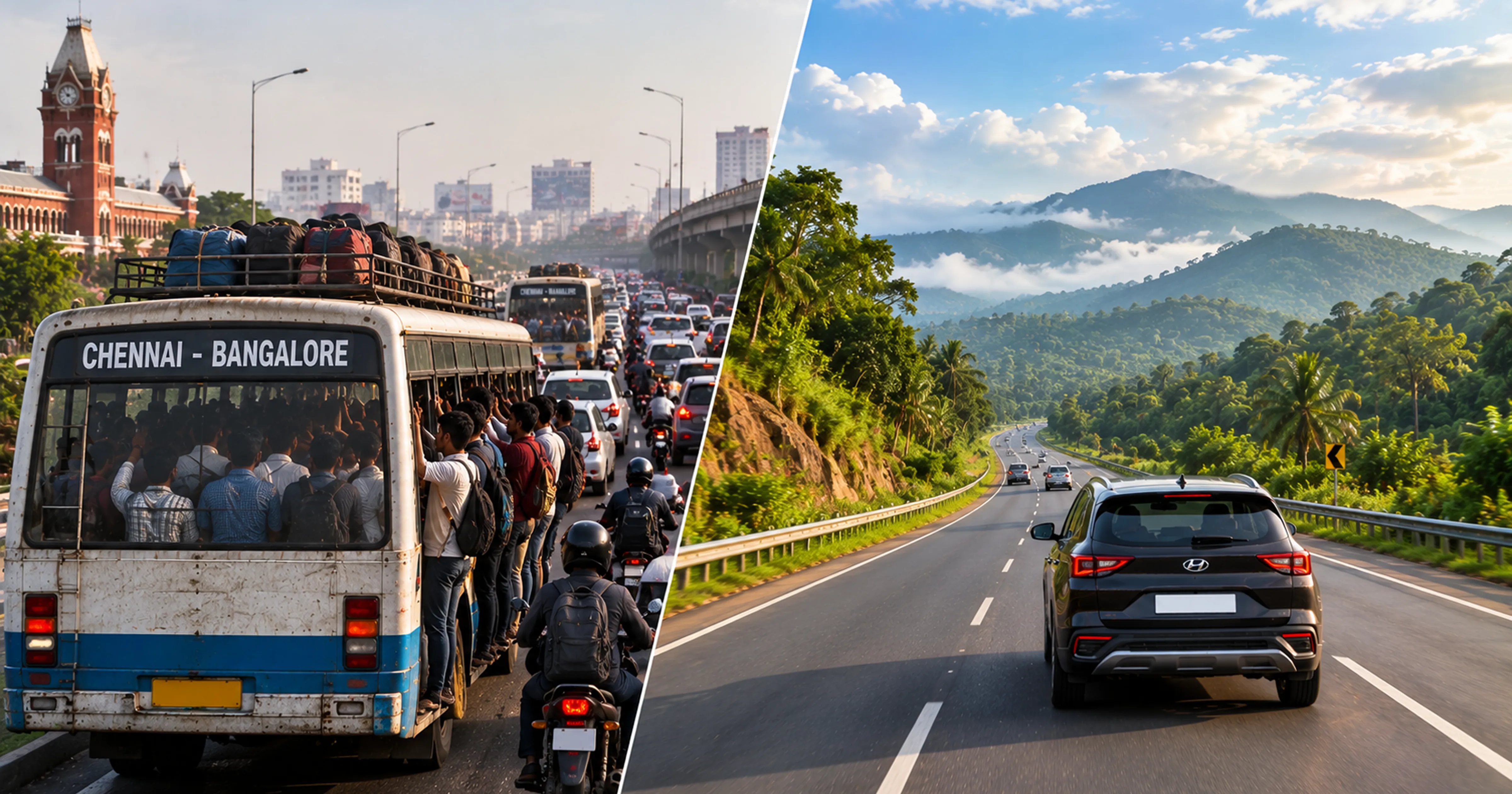
The city bus in Chennai and Bangalore has a specific problem that no policy announcement has solved in five years. Chennai's Metropolitan Transport Corporation carries over 100 passengers per bus in vehicles designed for 44 seated and 25 standing. The fleet has shrunk three consecutive years — from 3,454 buses in 2021 to 3,347 in 2023 to 3,392 in 2025. Daily ridership has fallen to 2.8 million from higher peaks as a vicious cycle of under-investment drives commuters away. The World Bank's Chennai City Partnership report identified this as an urgent transformation requirement. Experts say Chennai needs 7,000 buses — it has 3,392. Bangalore's BMTC runs approximately 6,300 buses across a city with one of the world's worst traffic congestion indices — 253.44 on the Numbeo Traffic Index, second only to Barranquilla globally. This guide compares exploring Chennai and Bangalore by city bus versus MM Miles self drive — honestly, situation by situation, with real numbers for what each option actually costs in money, time and comfort.
The State of City Buses in Chennai and Bangalore — 2026 Reality
Chennai — A Fleet That Is Shrinking While the City Grows
Chennai is the fourth-largest urban economy in India — electronics, manufacturing, automobiles and information technology. Its bus network, the Metropolitan Transport Corporation, is meant to be the backbone of how its residents move. In 2026 it is not functioning as that backbone.
The numbers from the MTC's own website: 3,454 buses in 2021. 3,347 in 2023. 3,392 in 2025. The fleet has not grown with the city — it has shrunk. During peak hours between 8-10 AM and 5-7 PM, buses operate at over 100 passengers in vehicles with a designed capacity of 44 seated and 25 standing. That is more than double the standing capacity and nearly three times the seated capacity. The World Bank's Chennai City Partnership report states directly: Chennai needs to double its fleet. Sooraj EM of ITDP India was more specific — first grow to 7,000 buses, then to 10,000. The current fleet of 3,392 is less than half of what is needed.
Bus stop coverage is also declining. The distance between stops has increased as the network has been rationalised — meaning passengers must walk longer to reach a stop, reducing the effective usability of the system. Peripheral areas of Chennai — the New OMR corridor, Perumbakkam, Medavakkam, Kelambakkam, the rapidly growing residential zones beyond Tambaram — have 'poor reach and frequency,' per UrbanWorks founder Shreya Gadepalli. One bus per 30-45 minutes in these areas during off-peak hours is documented.
Bangalore — More Buses, Still Not Enough for the World's Second-Most Congested City
Bangalore's BMTC operates approximately 6,300 buses — nearly double Chennai's fleet — across a larger geographic area. A veterinary student who commutes by bus and metro every day has stated publicly that the tickets and passes are costly relative to income. A junior college student from Hebbal described buying multiple tickets for a single journey as consuming unnecessary time and energy. Connectivity between areas in the city is 'inadequately designed,' with poor coordination between bus routes and rapidly growing commercial areas on Kanakapura Road and Mysore Road.
Bangalore's Numbeo Traffic Index of 253.44 — versus Chennai's 197.27 — reflects a city where even when a bus arrives on schedule, the journey time through congestion makes it uncompetitive with alternatives. A direct bus from Whitefield to MG Road covers 25 km — at Bangalore's average peak hour speed of 13-14 kmph, a bus in traffic takes 1 hour 45 minutes to 2 hours for this journey. The Namma Metro Purple Line extension to Whitefield reduces this to 45-50 minutes for the metro section — but the last-mile walk or auto from the office to the metro station adds back significant time.
The Direct Comparison — 8 Situations, Honest Scores
Situation 1 — Daily Commute in Central Areas
| Factor | City bus | MM Miles self drive |
|---|---|---|
| Cost per trip | ₹10-40 — cheap | ₹799/day covers all trips |
| Peak hour experience | 100+ passengers, standing, sweat | Air-conditioned, seated, private |
| Wait time at stop | 10-25 minutes peak hours | Zero — car in your parking |
| Journey time (15 km) | 45-75 min in bus traffic | 35-50 min same route |
| Multi-stop capability | Separate ticket each route | Drive to all stops freely |
| Verdict | Wins on per-trip cost only | Wins on everything else |
Situation 2 — Exploring Outskirt Areas and New Developments
This is where the bus fails most comprehensively. Chennai's New OMR corridor from Sholinganallur to Kelambakkam — one of the city's fastest-growing residential zones — has documented gaps in bus frequency. UrbanWorks research confirmed poor reach in the outskirts. For someone exploring a new residential area before buying or renting a home — checking commute timings, parking availability, neighbourhood feel at different hours — a bus that comes every 30-45 minutes is not a practical exploration tool. An MM Miles self drive car covers the same exploration on the renter's schedule — leave when you want, stop where you want, return when you are done.
In Bangalore, Sarjapur Road, Bellandur, Hennur Road and the areas beyond Electronic City Phase 2 all have BMTC frequency gaps. These are precisely the areas where the most new residential development is happening — and where potential residents most need to explore before committing. Bus is not the answer here. Self drive is.
Situation 3 — Group of Friends Exploring the City
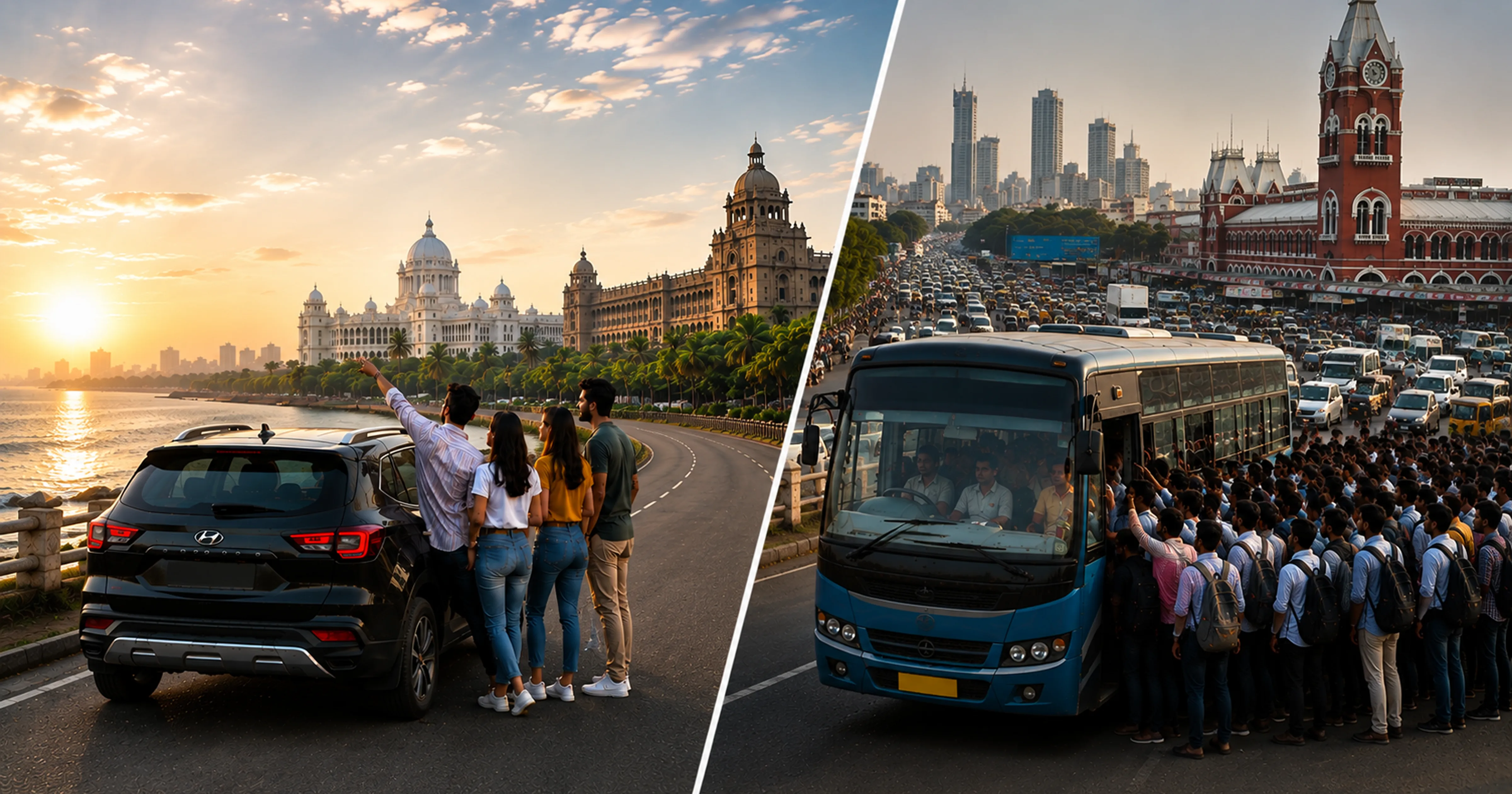
A group of 4 friends exploring Chennai or Bangalore for a weekend — Marina Beach, Kapaleeshwarar Temple, Mylapore filter coffee, T Nagar shopping for Chennai. Cubbon Park, Commercial Street, Lalbagh, Indiranagar 100 Feet Road for Bangalore. By bus: 4 people × ₹20-40 per bus trip × 6-8 bus journeys = ₹480-1,280 for the day, with 20-25 minute waits between each leg, and no flexibility to detour to something interesting discovered mid-route.
MM Miles Maruti Fronx at ₹799/day: ₹200 per person for the entire day. Zero wait between stops. Drive directly from Kapaleeshwarar Temple to Mylapore without a bus route needing to connect the two. Detour to Alwarpet on the way when someone mentions their favourite bakery is there. Return at 9 PM without worrying about last bus timing. Self drive wins by every measure except the per-km raw cost.
Situation 4 — Early Morning or Late Evening Travel
Chennai MTC bus services thin significantly after 9 PM — frequency drops, routes reduce and some peripheral services stop. By 10:30-11 PM many MTC routes have run their last bus. BMTC in Bangalore has similar late-evening gaps, particularly in outskirt corridors. For anyone needing to travel at 5 AM for a flight, 11 PM after a late work finish or midnight in a medical situation — the bus is not available, not reliable or not safe depending on the specific area.
MM Miles operates 24/7. The car is in your building parking at 3 AM when you need to leave for a 6 AM flight. It is available at 11 PM when you finish late at the office. The flat daily rate does not change whether you drive at 2 PM or 2 AM. For time-sensitive early or late travel, self drive wins completely.
Situation 5 — Exploring With Luggage, Equipment or Young Children
A Chennai bus at 8:30 AM peak hour carrying 100 passengers has no space for a stroller, camera equipment, a large shopping bag from T Nagar or a suitcase. Standing passengers are pressed against each other with no room for anything that takes floor space. Families with young children on crowded buses — particularly with prams or children who cannot stand for 45 minutes — face a genuinely difficult experience.
An MM Miles car has a boot for luggage, equipment and shopping. It has child seat compatibility. It can stop at a pharmacy, a supermarket and a restaurant without the purchase having to be carried on a crowded bus. For any travel involving goods, equipment, small children or the elderly — self drive is not a luxury preference. It is a functional requirement.
Situation 6 — Tourists Exploring the City for 1-2 Days
A visitor to Chennai for 2 days wanting to see the highlights — Marina Beach, Kapaleeshwarar Temple, Fort St George, DakshinaChitra, Mahabalipuram for a day trip — faces a specific bus challenge. The routes between these destinations are not direct. Multiple bus changes are required for some. The journey planning on an unfamiliar bus network is difficult without local knowledge. And the time lost to bus waits and indirect routing compresses a 2-day itinerary significantly.
MM Miles for a tourist: ₹799/day delivered to their hotel or accommodation. Freedom to visit Kapaleeshwarar Temple at 7 AM before the crowds, drive to Marina Beach for the morning, reach DakshinaChitra by noon, take a day trip to Mahabalipuram on day 2 — all without routing through an unfamiliar bus network. For a visitor with limited time in the city, every hour saved on bus logistics is an hour of actual exploration.
Situation 7 — Monthly Commuter on a Fixed Route
This is the one situation where the bus genuinely wins. A daily commuter on a fixed route — home in Tambaram to office in Guindy, home in Koramangala to office in Domlur — on a well-served trunk route with a monthly pass at ₹350-800 in Chennai or ₹800-1,500 in Bangalore has the lowest per-km transport cost of any mode. The bus wins on pure per-trip economics for regular commuters on covered routes.
The caveat: this only holds if the route is well-served, the commuter can tolerate peak-hour overcrowding, and the timing flexibility of the bus schedule matches their work requirements. The moment any of these conditions breaks — a new office location, a route gap, a change in work hours — the bus advantage evaporates. And the monthly pass wins in direct cost only. The time cost — 45 extra minutes per day on a bus versus a self drive car covering the same route in 30 minutes — is a personal calculation each commuter makes.
Situation 8 — Weekend Road Trip From the City
The bus has essentially no role in weekend road trip planning. TNSTC buses to Pondicherry, Yercaud and Kodaikanal exist but run on fixed schedules that do not allow the flexibility road trips require — stopping at Mahabalipuram on the ECR, pulling over for salt pan photography, arriving at a Coorg homestay at your own timing. KSRTC to Mysore, Coorg and Chikmagalur similarly operates on point-to-point schedules. For any weekend trip that involves exploration rather than just reaching a destination, the bus is not competitive with self drive.
The Complete Score — Bus vs MM Miles in 2026
| Category | City bus | MM Miles | Winner |
|---|---|---|---|
| Per-trip cost solo | ₹10-60 | ₹799/day (all trips) | Bus |
| Peak hour comfort | 100+ passengers, standing | Private, air-conditioned | MM Miles |
| Coverage — outskirts | Poor, 30-45 min frequency | All areas — home delivery | MM Miles |
| Wait time | 10-25 minutes peak | Zero — car in your parking | MM Miles |
| Multi-stop flexibility | Separate ticket each leg | Unlimited stops, any route | MM Miles |
| Early/late travel | Last buses by 10:30-11 PM | 24/7 availability | MM Miles |
| Groups (3-4 people) | ₹480-1,280/day total | ₹799/day split 4 ways = ₹200/person | MM Miles |
| Luggage and equipment | No space in crowds | Boot space, comfortable | MM Miles |
| Tourist exploration | Complex routing, waits | Hotel delivery, any route | MM Miles |
| Fixed route daily commuter | Monthly pass ₹350-1,500 | Higher per-day cost | Bus |
| Weekend road trips | Not viable | ₹799/day unlimited km | MM Miles |
| Environmental impact | Lower per-person emissions | Higher per-trip emissions | Bus |
Bus wins on two metrics: per-trip cost for solo travellers on covered routes, and environmental impact per person when buses are full (though at 100+ passengers the environmental claim is complicated by the discomfort and service-quality deterioration). MM Miles wins on 10 of 12 categories. This is not surprising — a private vehicle is more flexible than a shared public transport system by definition. The question is always whether the extra cost is worth the extra flexibility. For most situations in Chennai and Bangalore in 2026 — particularly given the documented overcrowding, fleet shortfall and outskirt coverage gaps — the answer is yes.
When the Bus Is the Right Choice — Being Honest
An honest comparison names when the bus wins. The bus is the right choice when you are a daily solo commuter on a well-served route with a monthly pass. When you are a student or pensioner for whom ₹10-60 per trip is the relevant budget constraint. When you are travelling at off-peak hours on a major trunk route and the overcrowding concern is minimal. When your destination is directly served by a frequent bus and you have no time pressure.
The bus is also better for the city's overall traffic and emissions when it is genuinely full — a full bus removes 44-100 car-equivalent journeys from the road. Supporting bus ridership has a systemic benefit that self drive does not provide. This is the honest argument for buses that no self drive rental company should dismiss. But in Chennai and Bangalore in 2026, the bus system's documented problems — fleet shortfall, overcrowding, outskirt coverage gaps, late-night gaps — mean that the systemic argument for supporting buses is constantly undermined by the practical argument of whether the bus actually serves your specific need.
For Chennai MTC bus information visit the Metropolitan Transport Corporation at mtcbus.tn.gov.in. For Bangalore BMTC bus routes and passes visit bmtcinfo.com. For Chennai urban mobility research visit the Institute for Transportation and Development Policy at itdp.in. For consumer transport feedback and surveys visit the National Consumer Helpline at consumerhelpline.gov.in.
Done waiting at bus stops in Chennai? MM Miles delivers your self drive car to your door — ₹799/day, zero deposit, home delivery to all Chennai areas including OMR, Adyar, T Nagar and the outskirts. Your schedule, not the bus schedule.
Book Self Drive Car in Chennai →Bangalore bus routes not covering where you need to go? MM Miles delivers across Whitefield, Koramangala, HSR Layout, Electronic City and all areas — ₹799/day flat, zero deposit, zero surge. Drive when you need.
Book Self Drive Car in Bangalore →