
This is the guide the car rental industry does not want written. Not because the information is secret — most of it is available in terms and conditions, regulatory filings and consumer complaints. But because no platform benefits from customers reading it carefully before booking. These 5 uncomfortable truths about Indian car rental are structural features of the market — not accusations against any specific company. Understanding them is the difference between making an informed booking and discovering them after they have already cost you money. MM Miles is not exempt from all of these — where it operates differently, that is stated clearly. Where the industry practice applies broadly, that is stated clearly too.
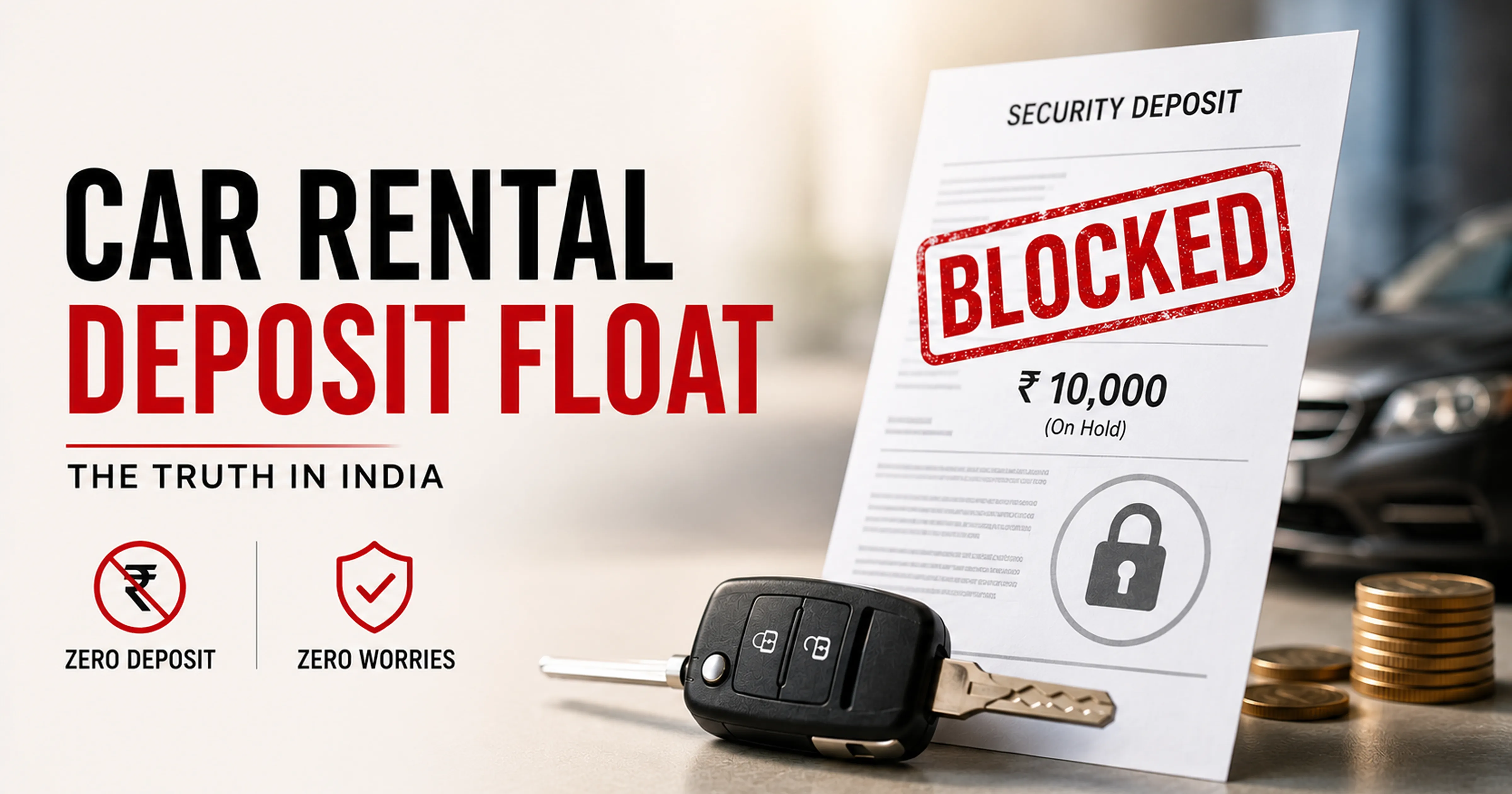
Uncomfortable Truth 1 — The Deposit Is Not Just About Risk. It Is About Float.
Every car rental platform that collects a security deposit will tell you the same thing: the deposit protects against damage. This is partially true. What they do not tell you is the other reason deposits exist.
When a platform holds ₹10,000 from 10,000 simultaneous bookings at any given time, that is ₹10 crore in their account. For a large platform with 100,000 active bookings, deposits may represent ₹100 crore or more in funds permanently available to the company — earning interest, available for operational purposes, functioning as working capital. This is called float. It is the same financial mechanism that makes payment companies profitable and why insurance companies can invest premium income before claims are paid.
The float generated by customer deposits is a meaningful revenue source for platforms — separate from the rental margin. This is not illegal. It is disclosed in the fine print. But it explains something that otherwise seems puzzling: why do well-capitalised rental platforms with genuine pre-delivery inspection processes (which reduce actual damage risk) still collect large deposits? Because the deposit serves two functions simultaneously — risk management and float generation. Understanding this helps you evaluate a 'zero deposit' claim more clearly. MM Miles charges zero deposit because the pre-delivery photo inspection process manages damage risk through documentation rather than through financial leverage over the customer.
Uncomfortable Truth 2 — Your Insurance on a Marketplace Car May Not Actually Cover You
This is the most serious and least discussed issue in Indian car rental — particularly on peer-to-peer marketplace platforms like Zoomcar and Revv where individual hosts list their personal vehicles.
A standard personal motor insurance policy in India — the kind that covers a privately registered car — has a commercial use clause. The India Motor Tariff, regulated by the Insurance Regulatory and Development Authority of India (IRDAI), specifies that personal motor insurance applies to private use of the vehicle. If the vehicle is being used commercially — which renting it to a stranger for a fee unambiguously is — the insurance company can reject a damage or accident claim on the grounds of commercial use without appropriate endorsement.
Not all marketplace hosts have updated their personal insurance with a commercial use endorsement. Some hosts list their cars without disclosing the rental activity to their insurer. Some platforms provide their own supplementary insurance layer — but the terms and exclusions of that supplementary coverage vary and are not always clearly communicated to renters at the time of booking.
What this means for you as a renter: if you have an accident in a marketplace rental car and the host's personal insurance rejects the claim on commercial use grounds, the situation becomes legally complex. The platform's supplementary insurance may or may not respond depending on their specific policy terms. This is not a hypothetical risk — it is a structural vulnerability in the marketplace car-sharing model that is documented in insurance law.
MM Miles owns every car directly and carries commercial-grade comprehensive insurance on every vehicle as the registered owner. There is no personal-insurance commercial-use gap. The insurance is commercial from the start because MM Miles is a commercial entity operating a rental fleet — exactly the use case the commercial motor insurance policy covers.
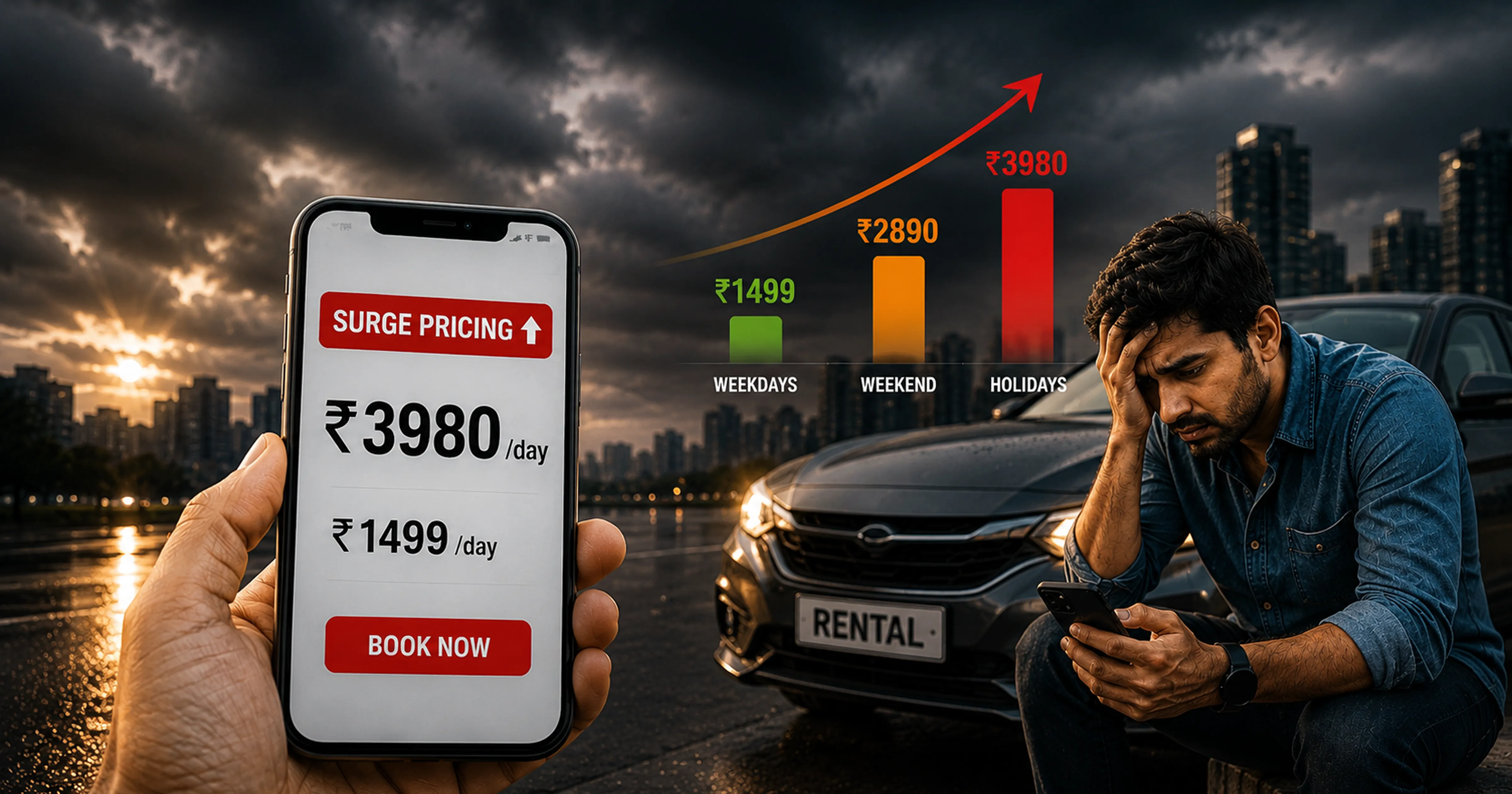
Uncomfortable Truth 3 — Dynamic Pricing Is Designed to Charge You Maximum When You Have No Alternatives
Dynamic pricing in car rental works identically to how it works in airline ticketing and cab aggregation — prices rise when demand exceeds supply. This is economically rational and companies are entirely transparent about it in their terms. But the practical effect is deeply uncomfortable when you examine it honestly.
The moments when you most urgently need a car are exactly when dynamic pricing charges you the most. Diwali weekend — when hundreds of thousands of people simultaneously want to travel and supply is limited — prices rise to their annual maximum. A cab driver cancellation at 8:30 AM when you have a critical meeting activates surge because other people have the same problem simultaneously. A natural disaster that forces evacuation — surge pricing during the 2023 floods in India was documented and controversial. Your personal urgency is invisible to the algorithm. All the algorithm sees is demand exceeding supply.
MM Miles does not use dynamic pricing. ₹799 on Diwali. ₹799 on a Friday evening when every other platform is surging. ₹799 the morning after a major event when cab alternatives are unavailable. This is not altruism — it is a business model choice. The same flat rate every day requires a different cost structure than dynamic pricing. But for customers, the practical benefit is straightforward: you know the price when you need the car, not just when you search on a slow Tuesday.
Uncomfortable Truth 4 — The Damage Claim Process Is Structurally Weighted Against Renters
Post-return damage claims are the most documented source of car rental disputes in India — on Trustpilot, on Consumer Helpline, on legal forums. The structural reason this happens is simple: the burden of proof falls on whoever does not have the documentation.
A car is delivered. The renter does not photograph the pre-existing scratches. The renter drives for 3 days. The car is returned. The platform notifies the renter 2 days later that a scratch was found and damage charges will be applied. The renter has no photographic proof the scratch was there at delivery. The platform has no photographic proof the scratch was not there at delivery. In this documentation gap, the dispute is almost always resolved in the platform's favour — because the platform holds the deposit and the burden of proof to avoid the deduction falls on the renter who did not document.
This is not fraud in the legal sense — most platforms genuinely believe the damage is new. But the structural incentive is misaligned. A platform that can charge deductibles from ambiguous damage situations has a financial incentive for ambiguity. MM Miles' mandatory pre-delivery walkaround inspection with timestamped photographs eliminates this ambiguity structurally. Both the renter and MM Miles have the same documented baseline before the keys change hands. If a scratch appears in the return photos that is not in the pre-delivery photos, it happened during the rental. If it is in the pre-delivery photos, the renter cannot be charged. No ambiguity, no disputes.
Uncomfortable Truth 5 — The Cheapest Displayed Price Is Almost Never the Real Price
Every comparison you see of car rental prices in India is comparing numbers that are not equivalent. The headline daily rate is only the beginning of what you actually pay.
| Hidden cost | Reality | Amount |
|---|---|---|
| GST on rental | 18% added at checkout if price is pre-tax | ₹144–₹324/day on Creta |
| Weekend surge | 30-50% premium on Fri-Sun | ₹300–₹600/day extra |
| Security deposit | Blocked on card, not charged but unavailable | ₹5,000–₹40,000 blocked |
| Accident deductible | Charged even when insurance covers repair | ₹5,000–₹15,000 |
| Fuel discrepancy charge | Disputed interpretation of fuel level at return | ₹500–₹3,000 |
| Late return fee | Calculated in hourly increments with ambiguous start | ₹200–₹1,000 |
| Cleaning fee | Charged if deemed excessively dirty | ₹500–₹2,000 |
| Towing charge | Separate from insurance, charged in some accidents | ₹1,500–₹5,000 |
The platform displaying a ₹999 daily rate and the platform displaying a ₹1,099 daily rate are not necessarily different in actual cost. The ₹999 platform might not include GST — making the real rate ₹1,178.82. It might apply weekend surge — making Friday ₹1,499. It might require a ₹10,000 deposit — blocking your money for 2 weeks. The ₹1,099 platform that includes GST, charges no surge and requires zero deposit may be significantly cheaper in actual total cost.
The test is always the same: go to checkout on any platform and look at the final charge before payment. Every fee that appears at checkout that was not visible during search is a hidden cost. MM Miles displays GST-inclusive prices at search, charges zero deposit, applies no surge pricing, and has zero deductible after accidents where rules are followed. The number you see at search is the number you pay.
How to Protect Yourself — The 7-Question Checklist
- Is GST included in the displayed price? Add 18% if not before comparing
- Is the price shown the weekend price or weekday price? Search for your actual travel date
- What is the exact security deposit amount? Confirm at checkout, not from the homepage
- Does the host's car have commercial motor insurance? Ask explicitly on marketplace platforms
- What is the accident deductible? Zero or ₹5,000-₹15,000 makes a significant difference
- What are the support hours? 24/7 human response or office hours with automated systems?
- Is there a mandatory pre-delivery inspection with photo documentation? If not, photograph everything yourself before accepting the car
For consumer protection regarding car rental disputes visit the National Consumer Helpline at consumerhelpline.gov.in under the Consumer Protection Act 2019. For motor insurance disputes and coverage questions visit the Insurance Regulatory and Development Authority of India at irdai.gov.in. For motor vehicle regulations visit the Ministry of Road Transport and Highways at morth.nic.in.
Want a rental where the price you see is the price you pay? MM Miles — GST included, zero deposit, zero surge, zero deductible after rules followed, pre-delivery photo documentation on every car. Chennai home delivery.
Book Transparent Self Drive in Chennai →Bangalore self drive without hidden costs. What you see at search is what you pay at checkout. Zero deposit, zero surge, delivered to your door.
Book Transparent Self Drive in Bangalore →