Two tools dominate how Indian road trippers plan their journeys in 2026. ChatGPT — which can build a detailed Chennai to Pondicherry itinerary with ECR stops, French Quarter recommendations and return route options in 45 seconds. And Google Maps — which knows exactly which petrol station on NH44 is open at 5 AM and how long the Mysore-Kushalnagar stretch will take in Monday morning traffic. The honest question is not which one is better. Both are better — at different things. ChatGPT leads on inspiration, itinerary structure and trip creativity. Google Maps leads on live data, navigation and real-time accuracy. The practical failure happens when people use ChatGPT for facts it cannot reliably provide — and end up driving to a restaurant that closed 8 months ago — or when people use Google Maps for inspiration it is not designed to provide and end up with a road trip that feels like a logistics spreadsheet rather than an experience. This guide covers exactly what each tool does well, where each one fails, which AI has the lowest hallucination rate for Indian travel planning in 2026, and how to use both together for the best road trip outcome — then get your MM Miles self drive car to actually do the trip.
What ChatGPT Does Well — The Road Trip Planning Superpower
ChatGPT's strength for Indian road trip planning is everything that requires creativity, synthesis and logical structure — and nothing that requires live, verified data.
1. Building Multi-Day Itineraries From Scratch
Ask ChatGPT for a 3-day self drive itinerary from Bangalore to Coorg and it returns a coherent, sequenced plan — NH275 to Mysore (day 1 afternoon stop), overnight near Kushalnagar, morning at Dubare Elephant Camp (day 2), Abbey Falls and coffee estate visit (day 2 afternoon), Raja's Seat sunset, Madikeri overnight, return via NH275 on day 3 with a Brindavan Gardens stop. This is useful, logical and structured. It would take 30-45 minutes to assemble manually by searching individually for each recommendation. ChatGPT does it in 45 seconds.
2. Explaining Why a Destination Is Worth Visiting
Google Maps can tell you where Edakkal Caves in Wayanad is. ChatGPT can tell you why you should go — that the cave contains prehistoric petroglyphs dating back to the Neolithic period, that the climb is 1.5 km and takes 45 minutes each way, that it is best visited on a weekday morning before 9 AM when crowds are thin, and that the cave system's discovery in 1890 by H.V. Conroy revealed some of the earliest evidence of human habitation in Kerala. That contextual richness transforms a GPS pin into a reason to make the journey.
3. Personalised Recommendations Based on Your Preferences
ChatGPT processes nuanced requests that Google Maps cannot handle. 'I am planning a 3-day Pondicherry trip from Chennai, I want mostly quiet experiences, I dislike crowded tourist spots, I am interested in colonial architecture, I am vegetarian and I am travelling with one other person in a self drive car.' Google Maps returns a list of Pondicherry attractions regardless of your preferences. ChatGPT builds a trip specifically around what you described — quiet beaches at dawn, the Aurobindo Ashram library rather than the Matrimandir, Surguru restaurant for vegetarian Tamil meals, the heritage walk through White Town rather than the crowded Promenade Beach area.
Where ChatGPT Fails — The Dangerous Gaps for Road Trippers
1. Outdated Information Presented as Current Fact
ChatGPT's training data has a cutoff date. It does not know that the restaurant it recommends in Madikeri closed 8 months ago. It does not know that a new toll booth opened on NH275 after its knowledge cutoff. It does not know the current petrol price in Bangalore is ₹110.82/litre or that the SH88 ghat section near Madikeri had a landslide last month that reduced it to single-lane traffic. It will present all of these as confident facts regardless.
Independent testing by TravelAnywhere in April 2026 found that ChatGPT (GPT-5.4) has an approximately 6% hallucination rate in travel contexts — meaning roughly 1 in 17 specific facts it states is incorrect. For a 50-item road trip itinerary, approximately 3 specific facts will be wrong. Some of these will be minor. Some — like a ghat road being closed or a fuel station not existing where indicated — could create genuine problems mid-trip.
2. No Live Traffic, No Real-Time Navigation
ChatGPT cannot tell you that the Outer Ring Road in Bangalore has a 45-minute delay right now due to an accident near Marathahalli. It cannot reroute you when the Mysore highway has a 2 km queue at Srirangapatna. It has no access to live traffic data and no navigation function. For the actual driving experience — the moment-to-moment routing that makes a road trip work — ChatGPT is entirely useless and Google Maps is entirely essential.
3. Cannot Verify Opening Hours or Current Status
When Gemini says a restaurant opens at 11 AM, it is pulling that from Google Maps — real-time, verified, updated by the business. When ChatGPT says a restaurant opens at 11 AM, it is pulling from training data that may be months or years old. Edakkal Caves has changing seasonal hours. Brindavan Gardens at KRS Dam has monsoon-specific operating times. The Bandipur Forest Department night driving ban hours were adjusted in 2025. ChatGPT likely has the old hours. Google Maps has the current ones.
What Google Maps Does Well — The Road Trip Essential
1. Real-Time Navigation and Live Traffic
Google Maps is the best real-time navigation tool available for Indian road trips in 2026. Live traffic data shows queue lengths on NH275, route alternatives when the Mysore highway is congested, and estimated arrival times that update minute-by-minute. For a Bangalore to Coorg drive, Google Maps will tell you that the SH88 ghat from Kushalnagar to Madikeri is currently 23 minutes slower than the historical average and suggest you depart 30 minutes earlier to maintain your planned arrival. No AI chatbot can do this.
2. Live Fuel Station, Hotel and Restaurant Availability
Google Maps shows which petrol stations on your route are currently open, their hours, user ratings and whether they have the fuel type you need. For a diesel SUV on a Coorg trip, knowing that the diesel station 15 km before the ghat is open at 7 AM versus the one at the base of the ghat that opens only at 9 AM is operationally important. Google Maps provides this with accuracy. ChatGPT provides it with plausible-sounding uncertainty.
3. Offline Maps for Signal Dead Zones
Download offline maps before entering ghat road signal dead zones. The SH88 from Kushalnagar to Madikeri has significant signal gaps through the coffee estate sections. The Yercaud ghat from Salem has poor connectivity through the hairpin sections. Downloaded Google Maps offline covers turn-by-turn navigation, basic place information and stored saved locations — working fully without internet through the most challenging sections of any South India road trip.
The AI Comparison — Which Has the Lowest Hallucination Rate for Indian Travel in 2026
Independent testing by TravelAnywhere.blog in April 2026 tested four AI tools on travel-specific fact accuracy across real itinerary planning tasks:
| AI Tool | Hallucination rate 2026 | Best for | Weakness |
|---|---|---|---|
| Claude 4.6 | ~4% | Complex itineraries, long-form planning, accurate research | No live data, no native Maps integration |
| ChatGPT (GPT-5.4) | ~6% | Flexible ideation, versatile questions, largest user base | Outdated facts, no real-time data |
| Google Gemini 3.1 | ~9% | Google Maps integration, live data via Google ecosystem | Less accurate than Claude for pure itinerary logic |
| Grok | ~12% | Real-time web search, current news | Highest error rate in travel-specific testing |
| Google Maps | Live data | Navigation, live traffic, current hours, fuel stations | Zero itinerary creativity, zero context explanation |
The practical implication for Indian road trippers: Claude 4.6 is the most reliable AI for building your trip plan and researching destinations accurately. ChatGPT is the most widely used and most versatile for quick itinerary generation. Google Gemini has unique value if you are already in Google's ecosystem — it can save places directly to Google Maps with one click and integrates with Google Calendar for trip scheduling. Google Maps is non-negotiable for the actual driving regardless of which AI you use for planning.
The Right Workflow — Using Both for Maximum Road Trip Value
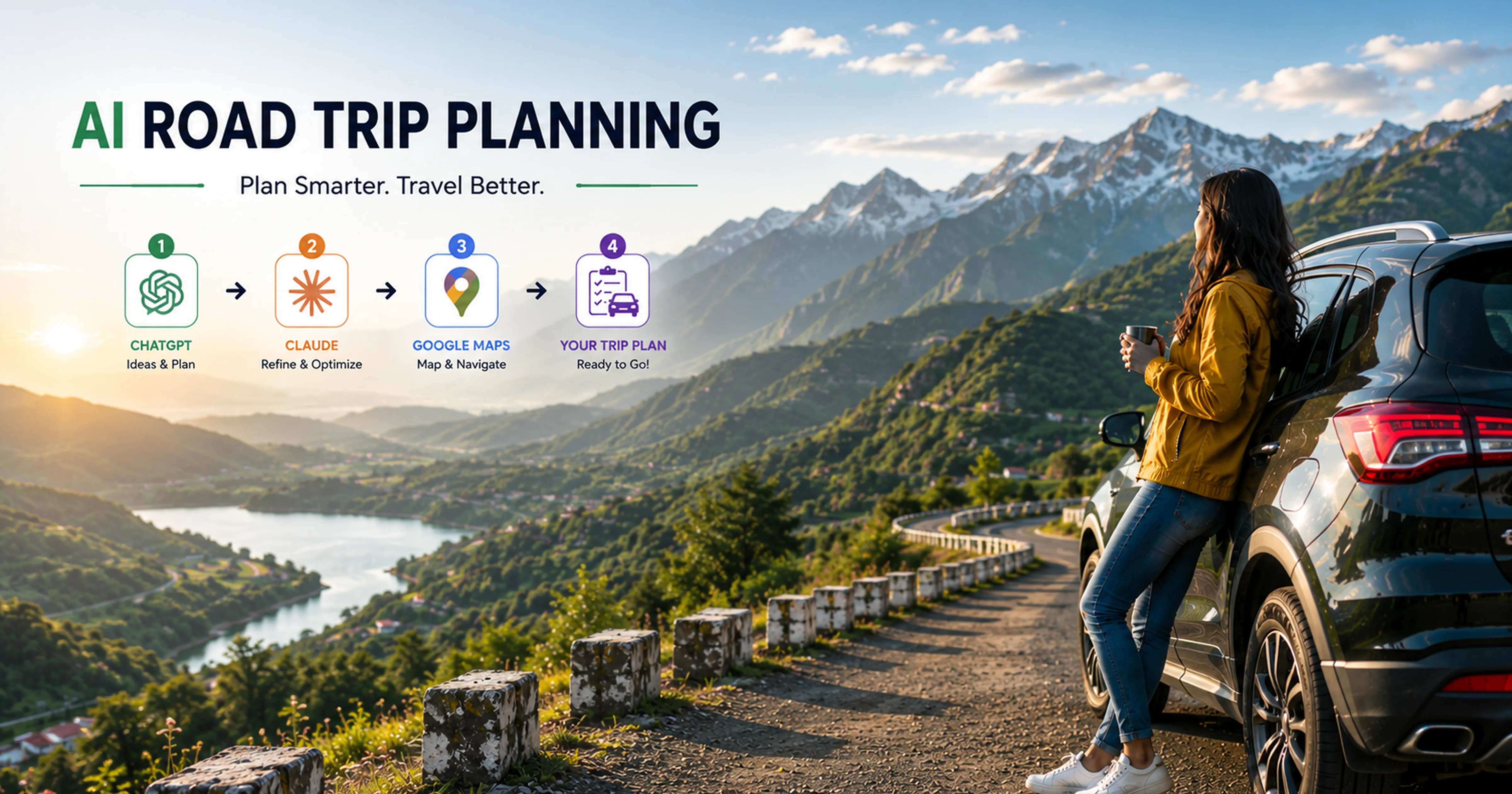
The most experienced Indian road trippers in 2026 use a 4-stage workflow that combines AI planning with Google Maps verification:
| Stage | Best tool | What you do | Output |
|---|---|---|---|
| 1. Inspiration and brainstorm | ChatGPT or Claude | Ask: 3-day road trip from Bangalore, coffee estates and waterfalls, August monsoon, group of 4 | Destination ideas, broad itinerary concepts |
| 2. Itinerary structure | Claude (lowest hallucination) or ChatGPT | Ask: detailed 3-day Bangalore-Coorg plan with driving times, stops, meal recommendations | Day-by-day plan with estimated times |
| 3. Fact verification | Google Maps + official sources | Check every specific recommendation — hours, distances, road conditions, accommodation | Verified, current, accurate data |
| 4. Navigation and driving | Google Maps — always | Turn-by-turn navigation, live traffic, offline maps downloaded before ghat sections | Real-time route guidance |
Stage 1 — Prompt ChatGPT or Claude for Ideas (5 minutes)
Start broad. Tell the AI your starting city, your group size, your time available, your interests and any constraints. 'Planning a self drive road trip from Chennai with 3 friends, 3 days in August, budget ₹15,000 per person all-in, interested in heritage and nature, one person does not eat meat.' This context produces recommendations that are actually tailored rather than generic. The AI generates the structure — you verify the specifics.
Stage 2 — Build the Itinerary With Claude (10 minutes)
Take the rough concept from Stage 1 and refine it with Claude — which has the lowest hallucination rate and best long-form reasoning for complex itinerary logic. Claude can sequence stops logically, estimate realistic driving times on specific Indian roads, flag monsoon-specific considerations for August trips, and build a detailed day-by-day plan that can be directly verified. Share the output as a list of specific things to check: restaurant names, attraction hours, accommodation names, route alternatives.
Stage 3 — Verify Every Specific Fact on Google Maps (15 minutes)
This step is non-negotiable. Every restaurant name — search on Google Maps and confirm current operating status and hours. Every hotel or homestay — verify it is still operating and check recent reviews for current quality. Every attraction — confirm current opening hours on the official website or Google Maps listing. Every route segment — check Google Maps for current road conditions and construction alerts. This 15-minute verification step prevents the situations that ruin road trips: driving to a restaurant that closed, arriving at a hotel that is full because it no longer accepts walk-ins, or reaching a viewpoint that is under renovation.
Stage 4 — Google Maps for the Actual Drive (Always)
No AI chatbot navigates. No AI chatbot shows you the traffic queue at Srirangapatna. No AI chatbot tells you the petrol station on the left in 3 km is open and the one on the right is closed. Google Maps does all of this. Have it running from the moment you start driving. Download offline maps for any section beyond reliable 4G signal. Set your destination and let it route around problems in real time.
The One Thing Neither AI Can Do — Provide the Car
ChatGPT can plan the perfect Bangalore to Coorg road trip in 3 minutes. Claude can add the low-hallucination verified context. Google Gemini can save every stop directly to your Google Maps account. Google Maps can navigate every kilometre of SH88 in real time. None of them can provide the car you need to actually do the trip.
MM Miles delivers a self drive car to your door in Chennai or Bangalore — Hyundai Creta diesel for 2-4 people, Toyota Fortuner for groups of 7, Maruti Fronx for a budget couple trip. ₹799/day flat. Zero deposit. Unlimited km. 24/7 support if the AI-planned route has a real-world surprise. Home delivery so you start the trip from your own address rather than spending 45 minutes getting to a rental depot. The AI plans the trip. MM Miles makes it happen.
Sample Prompt — Chennai to Pondicherry Road Trip
Copy this prompt into ChatGPT or Claude for a verified-accurate starting plan:
The last sentence in the prompt — 'I will verify all specific opening hours and restaurant details on Google Maps before finalising' — is not just a courtesy note to the AI. It is a mental commitment to the verification step that prevents every AI planning failure. The AI gives you the structure. Google Maps makes the structure real.
For official road conditions and travel advisories visit the Ministry of Road Transport and Highways at morth.nic.in. For Tamil Nadu tourism and road information visit tamilnadutourism.tn.gov.in. For Karnataka ghat road conditions visit aranyakavereonline.karnataka.gov.in.
AI planned your road trip. Google Maps verified the route. Now get the car. MM Miles self drive from ₹799/day — delivered to your door in Chennai, zero deposit, unlimited km. The trip is ready. So is the car.
Book Your Road Trip Car in Chennai →Bangalore road trip planned? MM Miles delivers Creta, Fortuner or Fronx to your door — ₹799/day, zero deposit, 24/7 support. ChatGPT planned it. MM Miles drives it.
Book Your Road Trip Car in Bangalore →